
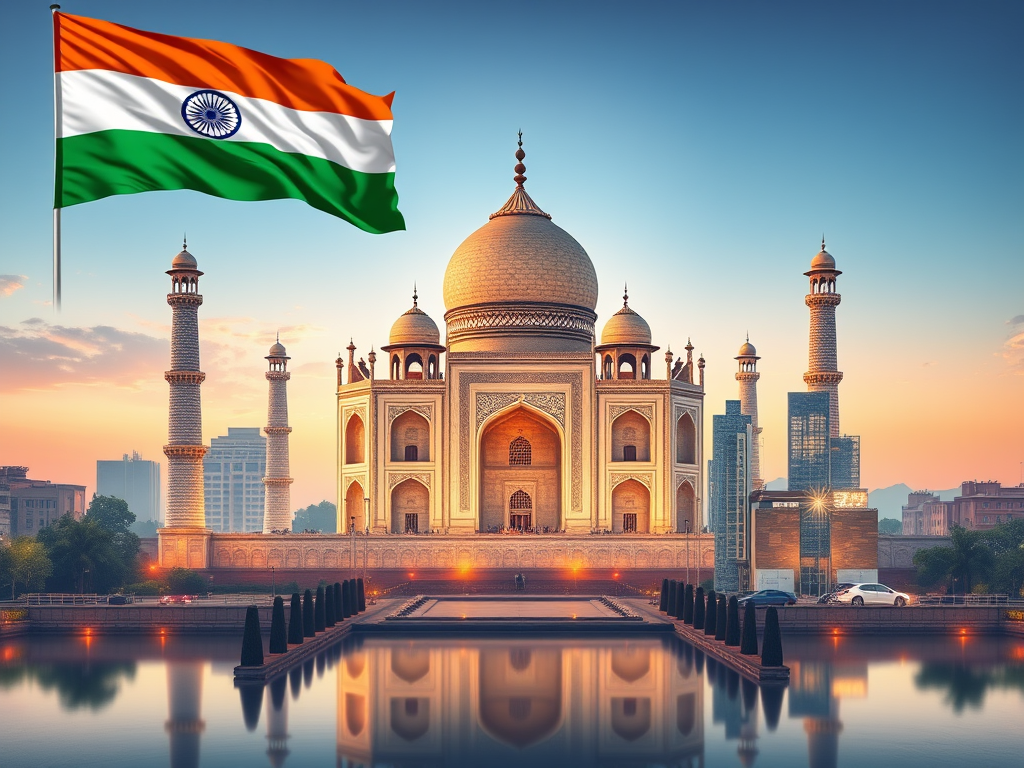
India is rapidly reshaping its global economic standing, with recent projections from the IMF’s World Economic Outlook (April 2025) confirming a historic milestone: India is set to become the fourth-largest economy in the world in 2025, surpassing Japan in terms of nominal GDP.
India’s Economic Growth Trajectory
According to the IMF:
- 2025: India’s GDP is projected at $4,187.017 billion, placing it ahead of Japan ($4,186.431 billion).
- 2027: India is expected to cross the much-anticipated $5 trillion GDP milestone.
- 2028: India will surpass Germany to become the third-largest economy, with an estimated GDP of $5,584.476 billion.
This trajectory reflects sustained economic momentum supported by domestic consumption, particularly in rural areas, and structural reforms aimed at boosting growth.
Top 10 Economies by Nominal GDP in 2025 (IMF Estimates)
| Rank | Country | Nominal GDP (in USD Billion) |
|---|---|---|
| 1 | United States | $30,507.217 |
| 2 | China | $19,231.705 |
| 3 | Germany | $4,744.804 |
| 4 | India | $4,187.017 |
| 5 | Japan | $4,186.431 |
| 6 | United Kingdom | $3,839.180 |
| 7 | France | $3,211.292 |
| 8 | Italy | $2,422.855 |
| 9 | Canada | $2,225.341 |
| 10 | Brazil | $2,125.958 |
Revised Growth Forecast and Contributing Factors
While India’s growth rate has been revised to 6.2% (down from 6.5%) due to rising global trade uncertainties, the outlook remains strong. The key contributors include:
- Robust private consumption in rural areas.
- A growing services and manufacturing sector.
- Government investment in infrastructure and digitization.
Implications for Global Trade and Economic Policy
India’s ascent brings transformative implications for the global trade ecosystem and economic power structures:
1. Shift in Global Trade Dynamics
- India as a Strategic Trade Partner: The country’s rise will likely draw increased foreign direct investment (FDI) and export-import partnerships.
- Reduced Overreliance on China: Companies and countries may diversify trade relationships toward India, particularly in light of geopolitical risks.
2. Heightened Global Competition
- Emergence of Indian Champions: Sectors like technology, pharmaceuticals, logistics, and clean energy will see Indian firms compete more aggressively on a global scale.
- Global Response: Other nations may respond by innovating, enhancing supply chain efficiency, and revisiting protectionist policies.
3. Policy and Trade Agreement Realignments
- Rise in Bilateral/Multilateral Agreements: Expect an uptick in India-centric FTAs and strategic economic partnerships.
- Trade Policy Shifts: Nations will need to recalibrate existing agreements to align with India’s growing economic weight.
4. Economic Stability and Leadership
- India as a Stabilizing Force: India’s consistent growth could offer balance against volatility in developed markets.
- New Opportunities for Emerging Markets: Developing countries could benefit through south-south trade and collaborative growth initiatives.
5. Global Supply Chain Realignments
- India as a Manufacturing Hub: With initiatives like Make in India, the country is becoming a preferred location for diversified supply chains.
- Resilience Through Diversification: Global firms are likely to restructure sourcing and manufacturing strategies to reduce single-point dependencies.
Conclusion: A New Economic Era
The IMF’s projection marks a turning point in the global economic narrative. India’s economic growth is not just a matter of national pride—it’s a defining shift in global trade and power equations. With strong fundamentals and strategic positioning, India is poised to play a central role in shaping the next phase of global economic development.


 Glottis Limited
Leave a comment