
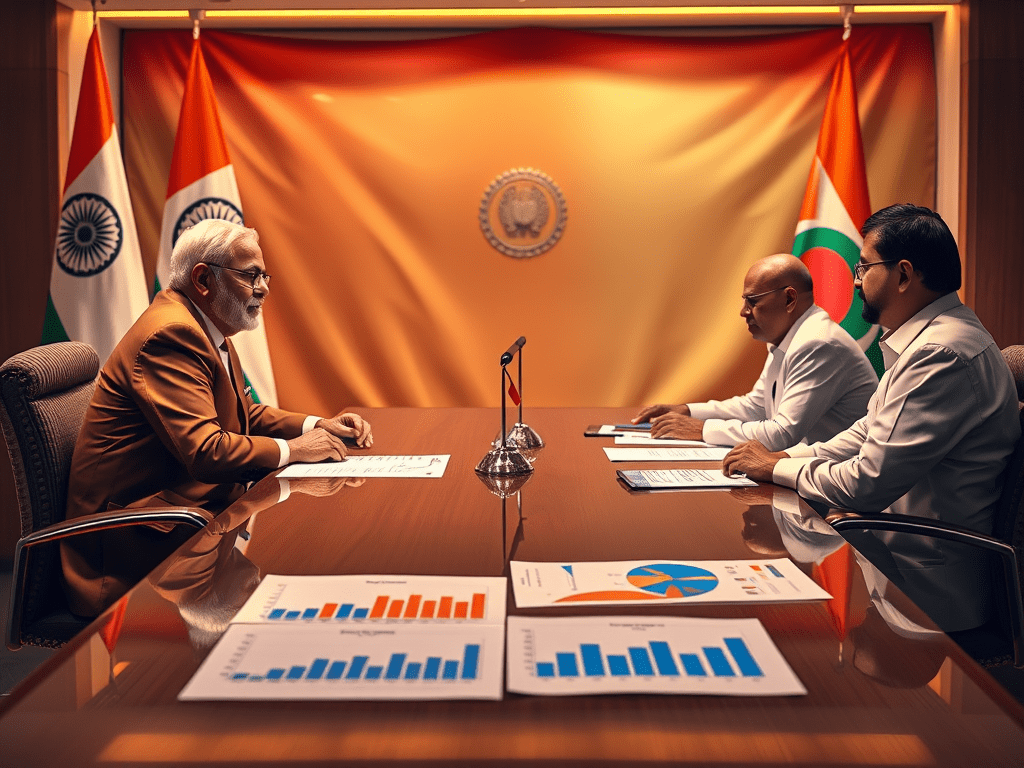
The trade relationship between India and Bangladesh—two critical partners in South Asia—is currently facing turbulence. Recent trade curbs imposed by India on key Bangladeshi goods have triggered concern, prompting Bangladesh to express its willingness to engage in dialogue to resolve the issue.
Backdrop of the Tensions
Sheikh Bashiruddin, the interim commerce adviser of Bangladesh, announced that Dhaka is open to negotiations with New Delhi to de-escalate the trade frictions. The call for talks follows India’s ban on several categories of Bangladeshi imports via road, reportedly in response to Bangladesh’s earlier restrictions on Indian yarn.
These retaliatory actions reflect a long-standing pattern of mutual trade barriers that periodically surface between the two nations—often rooted in domestic policy priorities and protectionist concerns.
Key Developments: Bangladesh-India Trade Stand-off
| Issue | Details |
|---|---|
| Talk Proposal | Bangladesh is ready for trade talks with India to resolve the dispute. |
| India’s Import Ban | Ban on Bangladeshi garments, snacks, drinks, and plastics via road routes. |
| Cause of India’s Action | Believed to be a reaction to Bangladesh’s restrictions on Indian yarn. |
| Lack of Formal Notice | Bangladesh has not received official notification from India yet. |
| Trade Impact | ~$770 million worth of goods affected; 42% of Bangladesh’s exports to India. |
| Production Focus | Bangladesh’s exports are largely driven by its domestic production. |
| Call for Liberal Trade | Bangladesh urges open markets to benefit both producers and consumers. |
| Historical Context | Both nations have imposed mutual trade restrictions in the past. |
Trade Impact at a Glance
India’s restrictions are estimated to impact goods worth $770 million, a significant chunk—approximately 42%—of Bangladesh’s total exports to India. The affected products include a diverse basket of:
- Ready-made garments
- Packaged snacks
- Beverages
- Plastic products
While the ban currently applies to road-based imports, alternative modalities such as rail or river routes are still under review.
Bangladesh’s Standpoint: Dialogue, Not Disruption
Commerce adviser Bashiruddin stressed the importance of avoiding escalation. Rather than engaging in retaliatory restrictions, Bangladesh prefers cooperative dialogue based on mutual benefit and economic interdependence.
He reiterated that Bangladeshi exports are largely self-sufficient and not overly reliant on Indian transshipment routes. The adviser further emphasized that liberal trade policies empower local businesses, promote efficiency, and ultimately benefit consumers across borders.
Conclusion: Time for Constructive Engagement
With trade being a cornerstone of bilateral relations, India and Bangladesh must move toward constructive engagement to prevent long-term disruptions. The willingness shown by Bangladesh to hold talks sets a positive tone.
As both economies are intertwined and share significant trade volume, ensuring open communication and avoiding protectionist spirals will be vital for regional stability, economic cooperation, and the shared goal of South-South trade integration.




 Glottis Limited
Leave a comment