
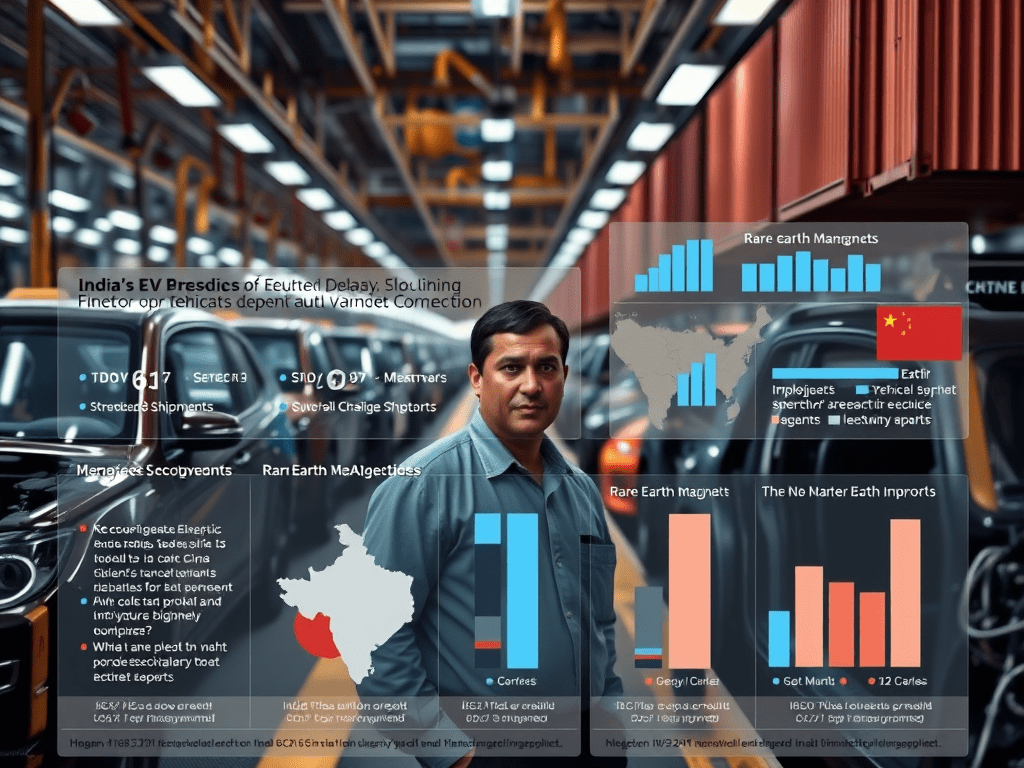
India’s automotive industry, especially the fast-growing electric vehicle (EV) segment, is facing a serious supply chain challenge due to export restrictions imposed by China on rare earth magnets. These critical components are essential for EV motor production, and any disruption poses a major threat to the country’s electric mobility targets.
Crisis Overview and Key Developments
A high-level delegation of Indian automotive leaders is preparing to visit China in an urgent bid to resolve bottlenecks that have stranded multiple rare earth magnet shipments.
| Key Development | Details |
|---|---|
| Delegation to China | Includes Siam and Acma officials; aims to fast-track shipment approvals |
| New Export Restrictions | Imposed by China on April 4, causing major shipment delays |
| Stranded Shipments | Multiple consignments stuck at Chinese ports |
| Urgent Impact Window | Production halts could begin as early as first week of June |
| Govt. Collaboration | Involves India’s commerce and external affairs ministries, and Beijing embassy |
| Critical Meeting | Scheduled for June 3 to finalize local production strategy |
India’s Dependence on Chinese Rare Earth Magnets
Rare earth magnets are vital for electric motors, particularly in EVs. China currently dominates the global rare earth supply chain, making India heavily reliant on imports.
| Aspect | China’s Share |
|---|---|
| Rare Earth Processing | 70–80% |
| Rare Earth Magnet Production | Over 90% |
This heavy dependence puts India in a vulnerable position, as delays or restrictions in exports from China can bring production lines to a standstill.
Potential Impacts on India’s EV Sector
The disruption is already triggering alarm across the industry. Several short- and long-term consequences are expected.
| Impact Area | Expected Outcome |
|---|---|
| Production Costs | Increased due to scarcity, likely to raise EV prices |
| Inventory Depletion | Rapid depletion pushing manufacturers to seek urgent alternatives |
| Supply Chain Disruption | May result in production halts, reduced output |
| EV Prices | Likely to increase in the short term due to material shortages |
| Consumer Demand | Could weaken due to rising prices, slowing EV adoption |
| Alternative Sourcing | Govt exploring domestic production and alternative international suppliers |
| Transition Costs | High capital investment needed for local manufacturing, raising costs temporarily |
India’s Strategic Response
In response to the growing crisis, India is formulating a multi-pronged approach:
- Diplomatic Engagement: Fast-tracking approvals via direct discussions with Chinese authorities.
- Domestic Capacity Building: The Ministry of Heavy Industries is planning incentives and public-private partnerships to boost local rare earth magnet production.
- Diversification of Supply Chains: Exploring alternative global suppliers to reduce dependency on China.
- Policy Action: A roadmap is expected to emerge from the June 3 meeting with stakeholders and ministries.
Conclusion: A Wake-Up Call for Self-Reliance
This crisis is a stark reminder of India’s over-reliance on a single source for critical components. While immediate diplomatic engagement may bring some relief, the long-term solution lies in strengthening domestic capabilities and diversifying supply chains. For now, consumers and manufacturers alike must brace for price volatility and potential production disruptions in the EV segment.


 Glottis Limited
Leave a comment