
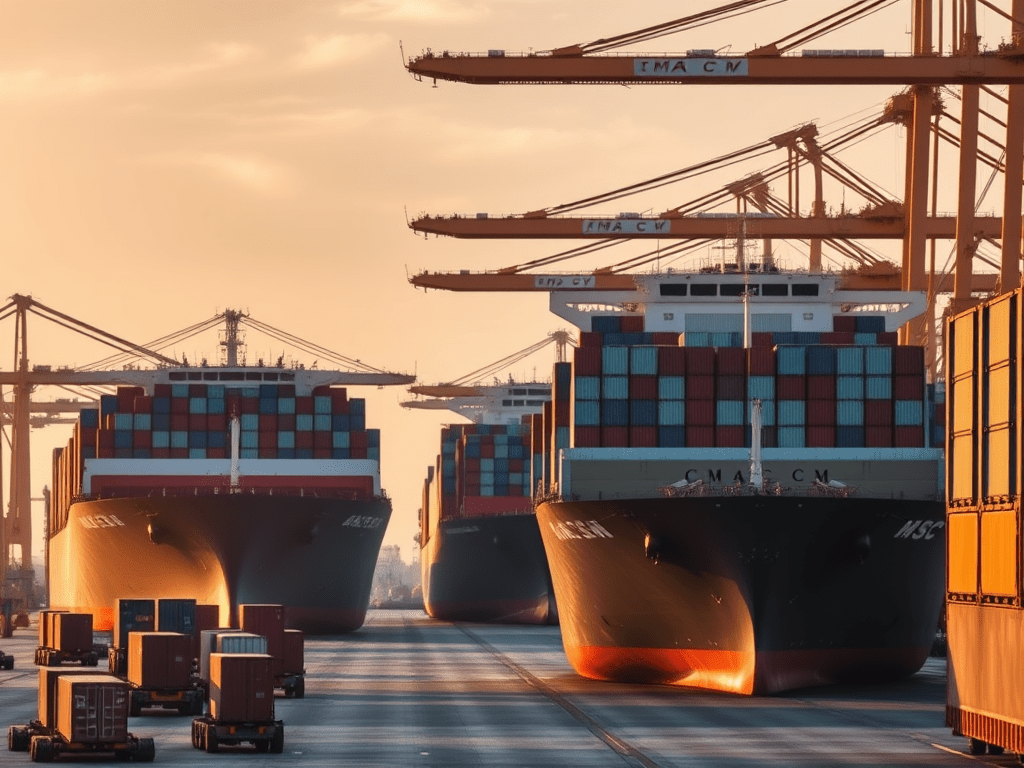
The global container shipping industry is undergoing a historic transformation, driven largely by the rise of strategic alliances and consolidations. These developments have not only reshaped market dynamics but also redefined how global trade is facilitated across oceans. The increasing dominance of a few major shipping alliances has given rise to improved operational efficiency but also raised questions about competition, service quality, and long-term sustainability.
Alliance-Driven Market Control
Today, 82.1% of the global container shipping capacity is controlled by just a few major players and alliances. This consolidation reflects a broader industry trend of collaboration to optimize costs, vessel utilization, and port coverage. These partnerships now dominate major trade lanes like Asia-Europe, Trans-Pacific, and Trans-Atlantic routes.
Key Players and Their Market Shares
| Alliance / Company | Members | Market Share (%) |
|---|---|---|
| Ocean Alliance | CMA CGM, COSCO, Evergreen, OOCL | 28.4% |
| Gemini Cooperation | Maersk, Hapag-Lloyd | 21.6% |
| The Alliance | ONE, HMM, Yang Ming | 11.5% |
| MSC (Independent) | Mediterranean Shipping Company | 20.6% |
| Non-Alliance Carriers | Independent operators (e.g., Wan Hai, ZIM, PIL) | 17.9% |
Highlights of Major Alliances
- Ocean Alliance: The largest in terms of market share, this group offers expansive global coverage and frequent sailings across key trade routes.
- Gemini Cooperation: Formed by Maersk and Hapag-Lloyd, this alliance focuses on digital integration, network efficiency, and carbon footprint reduction.
- The Alliance: Primarily strong in trans-Pacific and intra-Asia trades, this group is known for agile port-to-port services and regional connectivity.
- MSC: Though not in any formal alliance, MSC’s vast fleet and strategic port calls allow it to compete effectively with alliance-based operations.
Operational Efficiency & Competitive Pressures
Shipping alliances aim to maximize vessel utilization and reduce duplication of services, enabling:
- Reduced costs per TEU (Twenty-foot Equivalent Unit)
- Better scheduling and frequency
- Shared use of mega vessels and port infrastructure
However, non-alliance carriers, with just 17.9% market share, face growing challenges:
- Limited port pair offerings
- Less pricing power in freight negotiations
- Difficulty accessing key terminals dominated by alliance members
Implications for the Future
While alliances deliver cost savings and expanded coverage, they also:
- Reduce competition on major trade lanes
- Potentially lead to service homogenization
- Present challenges for regulators watching anti-competitive behavior
Stakeholders such as shippers, freight forwarders, and national regulators are increasingly scrutinizing these alliances for:
- Freight rate volatility
- Schedule reliability
- Environmental commitments
Conclusion
The container shipping industry has entered a new era where consolidation equals control. With four major entities steering over 80% of the world’s capacity, the future of global logistics will hinge on how these alliances evolve, adapt to digital disruptions, and balance profits with sustainability. For non-aligned carriers, innovation, niche specialization, and regional agility may be key survival strategies in a heavily consolidated market.




 Glottis Limited
Leave a comment