
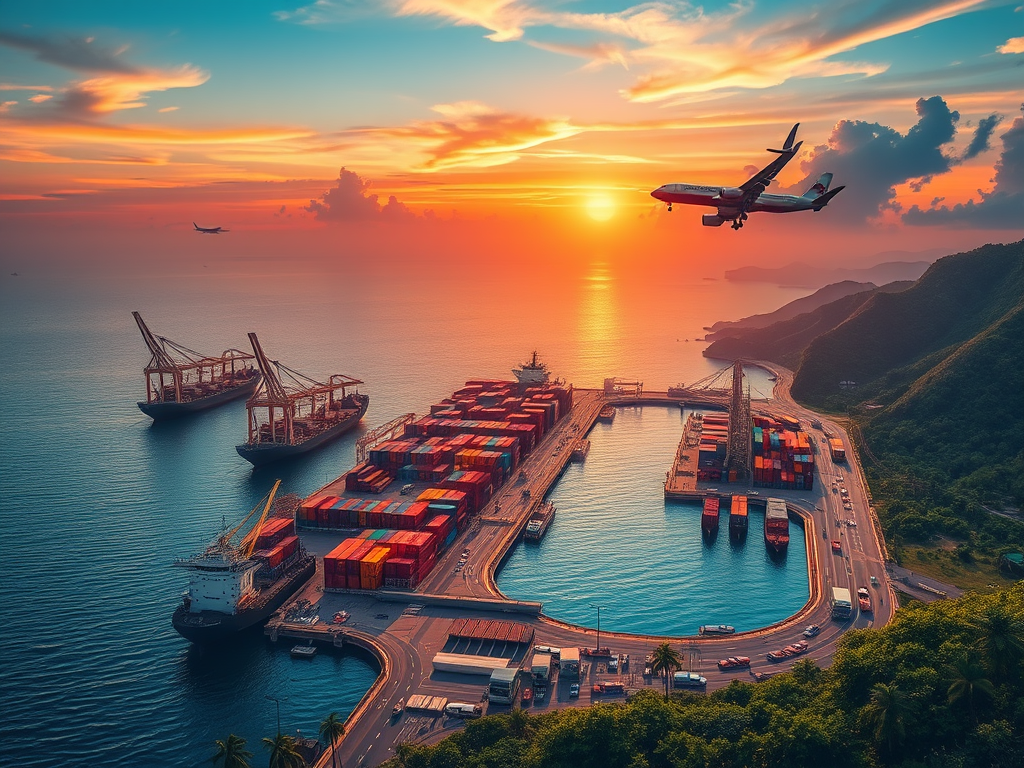
India’s ambitious ₹72,000 crore Great Nicobar Project represents one of the most transformative infrastructure initiatives in the country’s maritime history. With the goal of developing Great Nicobar Island into a strategic transshipment and trade hub comparable to Dubai’s Jebel Ali Port, the project seeks to position India as a dominant player in the Indo-Pacific trade corridor.
Key Project Data Overview
| Parameter | Details |
|---|---|
| Project Cost | ₹72,000 crore |
| Approval Year | 2021 (Union Cabinet) |
| Total Area Covered | 166 sq km (~10% of the island) |
| Project Duration | 30 years |
| Location of Port | Galathea Bay |
| Port Capacity | 14.5 million TEUs annually |
| Airport Runway Length | 3,300 metres (for wide-body aircraft) |
| Power Generation Capacity | 450 MW (Gas + Solar hybrid) |
| Planned Township Area | 16,569 hectares |
| Projected Population | Up to 65,000 residents |
| Target Cargo Capture | 20–30% of regional cargo currently routed via foreign ports |
| Completion Timeline | By 2050 (phased development) |
Project Overview
Approved by the Union Cabinet in 2021, the Great Nicobar Project spans an area of 166 sq km, roughly 10% of the island. Envisioned to be implemented over three decades, the project integrates multiple infrastructure components designed to catalyze trade, logistics, and regional development.
The initiative aligns with India’s Sagarmala and Gati Shakti programs, which aim to modernize maritime infrastructure and optimize connectivity across coastal and inland trade routes.
Major Components
- Transshipment Port at Galathea Bay
- Designed to handle 14.5 million TEUs per year, this port will enable India to capture a significant share of cargo traffic currently diverted to hubs like Singapore and Colombo.
- International Airport
- A greenfield airport featuring a 3,300-metre runway will accommodate wide-body international aircraft, improving connectivity for trade, tourism, and defense operations.
- 450 MW Power Plant
- A hybrid power facility integrating gas-based and solar energy to ensure reliable and sustainable electricity for the island’s operations and residents.
- Planned Township
- A new township spread across 16,569 hectares designed to house up to 65,000 people, including port workers, service providers, and residents, fostering a self-sustaining economic ecosystem.
Strategic and Economic Significance
The Great Nicobar Project is more than a developmental undertaking—it’s a strategic assertion of India’s maritime and geopolitical aspirations.
- Counter to Chinese Influence: Strengthens India’s maritime presence in the Indo-Pacific, providing surveillance and strategic reach near crucial shipping lanes.
- Reduced Reliance on Foreign Ports: Expected to capture 20–30% of regional cargo, minimizing dependency on external hubs such as Singapore and Colombo.
- Enhanced Regional Connectivity: Facilitates faster movement of goods between South and Southeast Asia, promoting India as a preferred logistics gateway.
Economic Benefits
| Key Area | Expected Impact |
|---|---|
| Trade Expansion | Capture 20–30% of regional transshipment traffic |
| Employment | Job creation for ~65,000 residents |
| Infrastructure Growth | Development of port, airport, township, and power infrastructure |
| Energy Security | Hybrid 450 MW power plant ensures energy independence |
| Tourism Boost | Promotes eco-tourism leveraging Great Nicobar’s biodiversity |
| Foreign Investment | Creation of a strategic economic and logistics zone |
| Local Development | Enhances livelihoods and supports community growth |
Environmental and Ethical Considerations
While the project promises immense economic and strategic value, it also raises serious ecological and ethical challenges.
Environmental groups and researchers have expressed concerns about potential deforestation, biodiversity loss, and the displacement of the indigenous Shompen Tribe. Critics argue that environmental clearances lacked sufficient transparency and consultation.
Balancing sustainable development with environmental preservation remains a key challenge for policymakers and developers alike.
Conclusion
The Great Nicobar Project encapsulates India’s vision of becoming a global maritime power — combining trade, strategy, and sustainability. Its success will depend on harmonizing economic ambition with ecological responsibility.
If implemented thoughtfully, Great Nicobar could emerge as the next strategic gateway to global trade, transforming India’s role in the Indo-Pacific while fostering economic resilience for decades to come.



 Glottis Limited
Leave a comment