
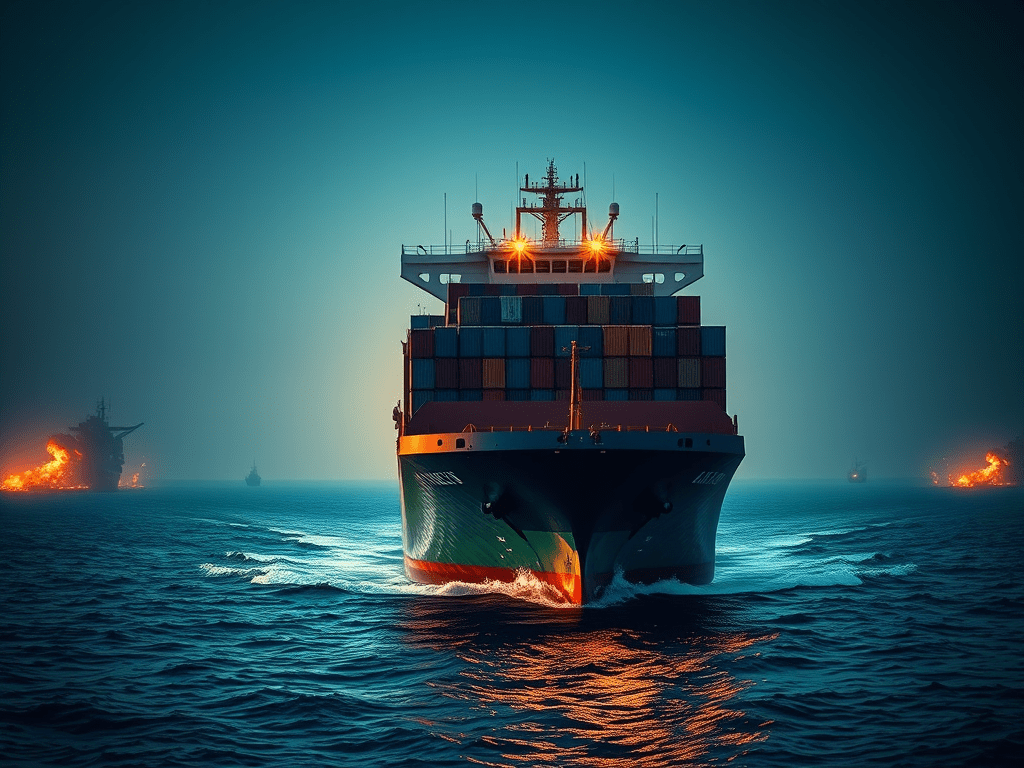
The recent attack on the container vessel ONE Majesty has highlighted the growing vulnerability of global shipping routes across the Gulf and the Strait of Hormuz. For India—a nation deeply integrated into maritime trade—the implications extend far beyond a single vessel incident.
India relies heavily on Gulf and Red Sea maritime corridors for energy imports, containerised exports, and trade connectivity with Europe and the United States. As geopolitical tensions intensify across the Middle East, the risk landscape for shipping is shifting rapidly, forcing logistics stakeholders to prepare for higher costs, longer transit times, and more complex supply chain planning.
The ONE Majesty Attack: A Warning Signal for Global Shipping
The ONE Majesty, a Japanese-operated container ship with a capacity of roughly 6,700 TEU, was struck by a projectile near the coast of the Ras Al Khaimah in the United Arab Emirates during the twelfth day of the ongoing conflict involving Iran. While the vessel suffered hull damage, the crew remained safe and the ship proceeded to safe anchorage.
What makes this incident particularly significant is that container vessels—traditionally seen as lower-risk targets compared to oil tankers—are now directly exposed to conflict-related attacks.
The incident occurred close to the Strait of Hormuz, one of the world’s most critical maritime chokepoints through which a large share of global oil and container trade flows.
Why This Matters for India
India’s trade routes pass directly through these volatile regions. The country depends on Gulf sea lanes for:
- Crude oil imports
- Exports to the Middle East
- Trade connectivity with Europe and the US via the Red Sea corridor
Any instability across the Red Sea, Arabian Sea, or the Strait of Hormuz can therefore have immediate ripple effects on Indian shipping schedules, freight rates, and supply chains.
Key Data: India Shipping Risk Exposure
| Factor | Key Data | Impact on India |
|---|---|---|
| Vessel attacked | ONE Majesty (~6,700 TEU) | Confirms container ships are potential targets |
| Location | Near Ras Al Khaimah, UAE | Close to Strait of Hormuz chokepoint |
| Strategic corridor | Hormuz + Red Sea trade lanes | Core routes for India–Europe & India–Middle East trade |
| Rerouting risk | Cape of Good Hope diversion | Adds ~15–20 days transit |
| Freight implications | Higher bunker + insurance premiums | Increased logistics cost for exporters/importers |
| Industry exposure | Oil, textiles, chemicals, engineering goods | Margin pressure across key sectors |
Immediate Operational Impact on Indian Trade
Shipping companies and exporters are already seeing operational disruptions.
A recent incident involved a cargo vessel bound for Kandla Port that caught fire after an Iran-linked attack, forcing crew evacuation. Such events illustrate how India-linked vessels are increasingly exposed to regional conflict.
If tensions escalate, carriers may begin diverting vessels away from the Red Sea corridor and instead route ships around the Cape of Good Hope.
Transit Time Comparison
| Route | Typical Transit | Diverted Transit | Additional Time |
|---|---|---|---|
| India – Europe | 20–25 days | 35–45 days | +15–20 days |
| India – US East Coast | 30–35 days | 45–55 days | +15–20 days |
This has three major consequences:
- Higher freight rates
- Reduced schedule reliability
- Increased working capital requirements for exporters
Sectors in India Most at Risk
Several Indian industries depend heavily on predictable shipping schedules and competitive freight costs.
| Sector | Exposure | Risk from Disruption |
|---|---|---|
| Oil & Gas | Crude imports via Gulf | Price spikes and energy security risks |
| Textiles & Apparel | Time-sensitive exports to Europe/US | Delivery delays and margin erosion |
| Chemicals & Petrochemicals | Bulk containerised exports | Freight volatility |
| Automotive & Engineering | Scheduled liner shipping | Production planning disruptions |
| Electronics & Consumer Goods | Just-in-time supply chains | Inventory shortages |
Strategic Risks for the Indian Economy
Beyond logistics disruptions, sustained instability across Middle Eastern trade routes could also influence macroeconomic indicators in India.
Key risks include:
- Higher marine insurance premiums
- Rising crude oil prices
- Inflationary pressure on imported goods
- Exchange rate volatility
For an economy deeply dependent on maritime trade, maintaining secure sea lines of communication remains a strategic priority.
Implications for Freight Forwarders and Logistics Companies
For freight forwarders, NVOCCs, and logistics providers, the ONE Majesty incident marks a shift in operational risk planning.
Traditional Gulf port calls—once considered routine—must now be evaluated with enhanced security and contingency planning.
Key Operational Adjustments
| Area | Required Action |
|---|---|
| Routing Strategy | Evaluate safer alternative corridors |
| Customer Communication | Provide proactive updates on surcharges and delays |
| Contract Structuring | Include war-risk and emergency surcharges |
| Shipment Planning | Increase lead times and buffer inventory |
| Risk Monitoring | Real-time geopolitical and maritime intelligence |
Forwarders must increasingly act as risk managers for supply chains, not just cargo coordinators.
Policy and Strategic Response from India
India is likely to strengthen maritime security and diplomatic engagement to protect critical shipping routes.
Possible responses include:
- Increased naval deployments in the Arabian Sea
- Cooperation with global maritime security alliances
- Greater monitoring of threats to India-linked vessels
- Diversification of trade corridors and logistics routes
These measures mirror earlier anti-piracy missions but will now address state-linked or proxy maritime threats.
Practical Takeaways for Indian Industry
Businesses dependent on international shipping should prepare for prolonged volatility.
Recommended actions:
- Develop 3–12 month disruption scenarios
- Build contingency planning for Cape routing
- Review Incoterms and risk allocation
- Increase inventory buffers and shipment lead times
- Monitor freight surcharges and insurance changes
Conclusion
The attack on the ONE Majesty underscores a new reality in global shipping: maritime trade routes can rapidly become geopolitical flashpoints.
For India—one of the world’s fastest-growing trading economies—the challenge is to adapt quickly through stronger maritime security, diversified trade corridors, and smarter logistics planning.
For the logistics and freight forwarding industry, this evolving risk landscape reinforces a critical shift: from managing cargo movement to managing supply chain resilience.



 Glottis Limited
Leave a comment