
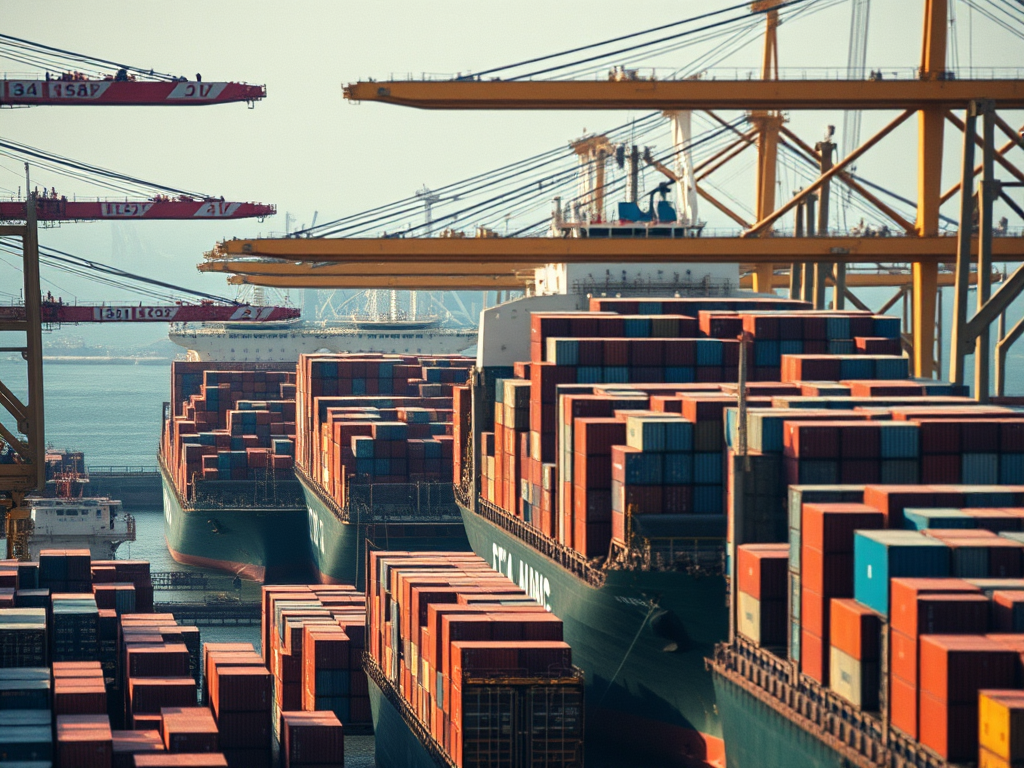
The anticipated reshuffling of container shipping alliances in 2025 has intensified competition among liner operators, who are now vying for greater market share even as freight rates continue to fall. Liner operators are focusing on capacity expansion, evidenced by their aggressive chartering activities despite the weakened demand, with minimal vessels left idle in the market.
Linerlytica’s latest report highlights the ongoing industry dynamics, noting that as of now, only 37 vessels (77,185 TEU) remain unemployed, constituting just 0.3% of the active fleet. Demand for tonnage remains high, and operators are seizing available capacity on the charter market over the coming months. However, this aggressive approach challenges the industry’s capacity discipline and could disrupt plans for a General Rate Increase (GRI) in the Asia-Europe sector slated for 1 November.
Key Trends and Statistics
- Idle Fleet and Tonnage Demand: Linerlytica reports only 0.3% of the fleet is idle, while demand for additional tonnage remains strong.
- Asia-Europe Capacity Surge: Currently, 504 vessels (7.33 million TEU) operate on Asia-Europe routes, a 25% year-on-year increase.
- GRI Challenges: Operators’ reluctance to reduce capacity could hinder the planned GRI of $1,000-$2,000 per 40-foot container for the Asia-Europe trade lane.
- US Routes: Asia-USEC capacity decreased by 3% year on year due to recent strikes, while Asia-USWC capacity surged by 22%, now totaling 2.67 million TEU across 312 vessels.
- High Charter Demand: Leading operators such as Maersk, CMA CGM, Cosco, Hapag-Lloyd, and Evergreen are securing new charters, with vessel availability becoming limited across all size segments.
Market Impact
The situation poses a potential downside risk for freight rates, especially on major routes. The continued hiring activity suggests that operators expect strong trade volumes into 2025. However, the risk of overcapacity could amplify price pressures in an already fragile market. Carriers may struggle without reductions in Asia-North Europe capacity. They could find it difficult to stop the fall in freight rates. Achieving a balanced market in the coming year will be challenging.
Key Details
| Aspect | Details |
|---|---|
| Idle Fleet | 37 vessels (77,185 TEU, 0.3% of active fleet) |
| Current Charter Demand | High, with all available tonnage expected to be secured in the next two months |
| GRI for Asia-Europe | Planned $1,000-$2,000 per 40ft container, with challenges due to high capacity levels |
| Asia-Europe Routes | 504 vessels, 7.33 million TEU, a 25% increase YoY |
| Asia-USEC Capacity | Down 3% YoY, 254 ships, 2.72 million TEU |
| Asia-USWC Capacity | Up 22% YoY, 312 ships, 2.67 million TEU |
| Key Chartering Operators | Maersk, CMA CGM, Cosco, Hapag-Lloyd, Evergreen |
| Vessel Availability | Limited across all sizes, with forward fixtures now common for 1,500-3,000 TEU vessels |
Outlook
With the 2025 alliance reshuffle, operators are bracing for a competitive battle to solidify their market position. High capacity and low idle rates highlight the unpredictability in freight rates. Additionally, companies are focused on expanding services despite softened demand. This strategy affects market share distribution in the near future.
Stay tuned to Glottis Global for more insights and industry updates as the shipping landscape continues to evolve.
#ShippingNews #FreightRates #ContainerShipping #SupplyChain #LinerShipping #MarketShare #OceanFreight #AsiaEuropeTrade #USPortStrikes #ShippingAlliances #GlobalTrade #FreightForwarding #MaritimeIndustry #LogisticsNews #Chartering #Glottislimited #Glottisganesha




 Glottis Limited
Leave a comment