
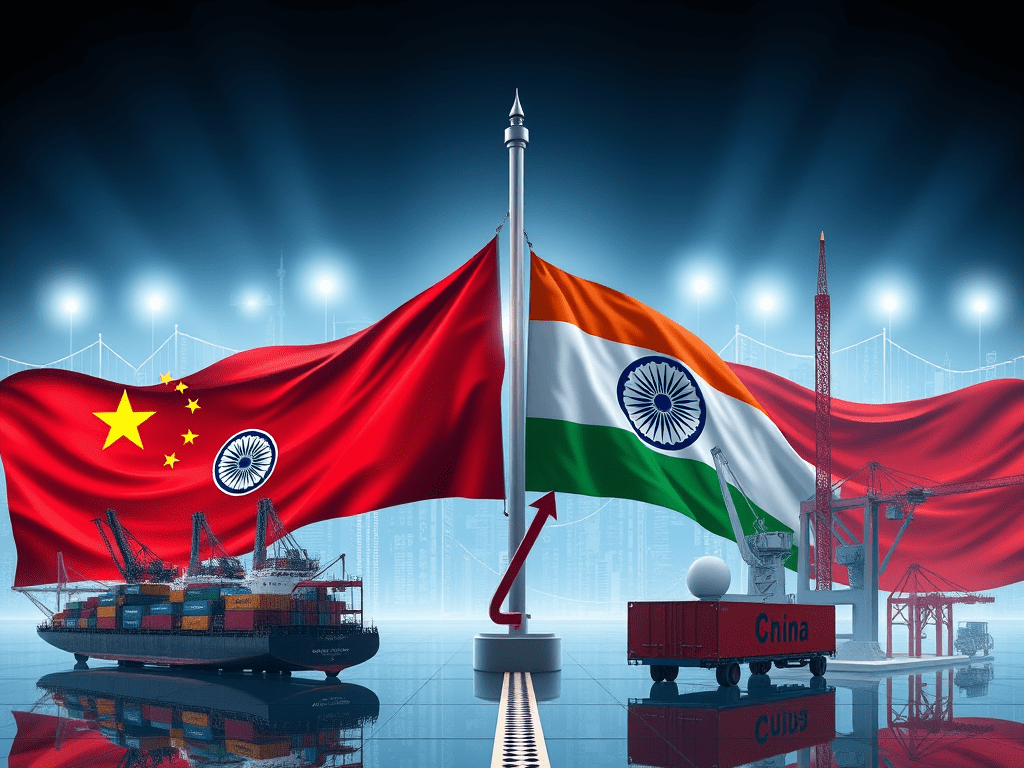
The escalating trade war between the United States and China has not only reshaped global trade dynamics but also presented significant opportunities for nations like India. As geopolitical rivalry between the world’s two largest economies intensifies, India is poised to play a pivotal role in the evolving global semiconductor supply chain.
US-China Trade Tensions: A Snapshot
- The US Takes Aim:
Recent US export controls have tightened restrictions on chip-making equipment, advanced software, and high-bandwidth memory chips, directly targeting China’s semiconductor sector. This marks a significant escalation in the ongoing trade war. - China’s Retaliation:
In response, China has imposed a ban on exporting key materials like gallium, germanium, and antimony, all crucial for semiconductor and telecommunications industries. - Geopolitical Rivalry Unfolds:
This tit-for-tat underscores the deepening rivalry between the two economic giants, with ripple effects being felt across the global trade ecosystem.
Opportunities for Neutral Economies
As the US and China lock horns, neutral economies like India are emerging as beneficiaries, leveraging the disruptions to gain a foothold in critical industries.
India’s Strategic Move into Semiconductors
India is aggressively advancing its semiconductor manufacturing capabilities, seizing the opportunity to integrate into global supply chains shifting away from China.
- Boosting Government Support:
The Indian government is increasing its semiconductor incentive funding from $10 billion to $15 billion, a bold move to attract global investments. - Tata’s Bold Initiative:
Tata Group, in partnership with Taiwan’s Powerchip Semiconductor Manufacturing Corporation, is investing over ₹91,000 crore to establish India’s first commercial chip fabrication plant. - Assembly & Testing Facilities:
Three approved assembly and testing plants further bolster India’s efforts to strengthen its position in the semiconductor supply chain.
India’s Role in Mitigating Trade Fragmentation
A Broader Perspective
Gita Gopinath, the First Deputy Managing Director of the IMF, highlighted India’s growing significance in mitigating the effects of global trade fragmentation. Unlike the Cold War era, today’s trade disruptions are costlier due to the higher integration of goods trade with global GDP.
A Rising Opportunity
India, Vietnam, and Mexico have steadily gained market share as China’s exports to the US have declined since 2019. These economies are well-positioned to fill the void, with India strategically focusing on semiconductors as a critical growth area.
Conclusion
The US-China trade war has accelerated the realignment of global supply chains, creating both challenges and opportunities. India’s proactive steps in semiconductor manufacturing, backed by strong government support and private sector initiatives, could redefine its role in the global technology ecosystem.
As the semiconductor industry becomes a key battleground in geopolitical rivalries, India is emerging as a potential winner, leveraging its neutral stance and strategic initiatives to carve out a significant niche in this critical sector.




 Glottis Limited
Leave a comment