
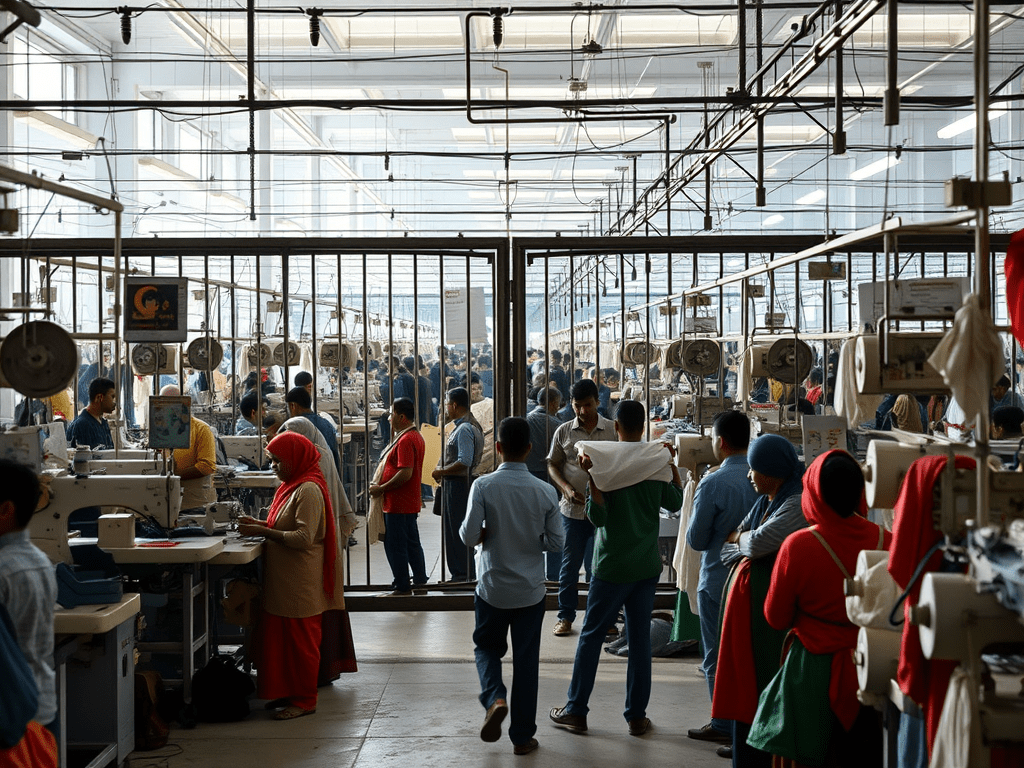
Overview
The garment industry is the backbone of Bangladesh’s economy, contributing nearly 84% of the country’s foreign exchange earnings. However, recent developments have raised concerns about its sustainability and future. A combination of factory closures, labor unrest, political instability, and increased competition is threatening the sector’s stability.
Key Data on the Garment Industry Crisis
| Factor | Impact | Data & Trends |
|---|---|---|
| Economic Contribution | Major foreign exchange earner | Accounts for 84% of Bangladesh’s total exports |
| Factory Closures | Declining production capacity | 76 factories shut down in the past year |
| Job Losses | High unemployment, mainly women | Over 50,000 workers affected |
| Automation Impact | Workforce reduction | 30.58% decline in garment workforce |
| Labor Protests | Disruptions in production | Increasing strikes over wages and conditions |
| Political Instability | Increased uncertainty | Resignation of Prime Minister Sheikh Hasina |
| Competition | Market share decline | Vietnam & Cambodia gaining prominence |
| Cotton Prices | Higher production costs | Dependency on imports leading to rising costs |
| Worker Conditions | High pressure, stress, health risks | Introduction of productivity-tracking devices |
Causes of the Crisis
- Factory Closures & Automation
- At least 76 garment factories have shut down in the past year, leading to significant job losses.
- The rise in automation has displaced workers, with 30.58% fewer employees required for production.
- Labor Unrest
- Frequent protests over poor wages and working conditions have resulted in work stoppages and additional factory shutdowns.
- Many workers face extreme pressure, monitored by productivity-tracking devices, leading to stress-related health problems.
- Political Uncertainty
- The resignation of Prime Minister Sheikh Hasina and the transition to an interim government have created instability, impacting business confidence.
- Factory owners are concerned that without government intervention, more closures will follow.
- Competitive Pressure
- Bangladesh is facing stiff competition from Vietnam and Cambodia, which are attracting global buyers due to better trade policies and lower political risks.
- Without modernization and policy reforms, Bangladesh risks losing market share in the global garment trade.
Future Outlook: Challenges & Opportunities
| Key Factor | Challenges | Opportunities |
| Automation | Job losses, need for retraining | Enhanced productivity and competitiveness |
| Political Stability | Government support uncertain | Potential policy reforms to stabilize the industry |
| Competition | Losing market share to Vietnam | Upgrading infrastructure and improving labor conditions |
| Labor Relations | Strikes, wage disputes | Better working conditions can improve stability |
| Sustainability | Higher costs for compliance | Meeting global demand for ethical production |
| Modernization | High investment required | Long-term efficiency and cost reduction |
Conclusion
Bangladesh’s garment industry is at a crossroads. While automation and modernization offer long-term efficiency gains, rising competition, labor unrest, and political uncertainty present significant hurdles. Without strong government support, labor policy reforms, and strategic industry shifts, the industry risks further decline. However, by focusing on sustainability, improved worker conditions, and competitive modernization, Bangladesh can regain its footing in the global market and sustain its economic growth.




 Glottis Limited
Leave a comment