
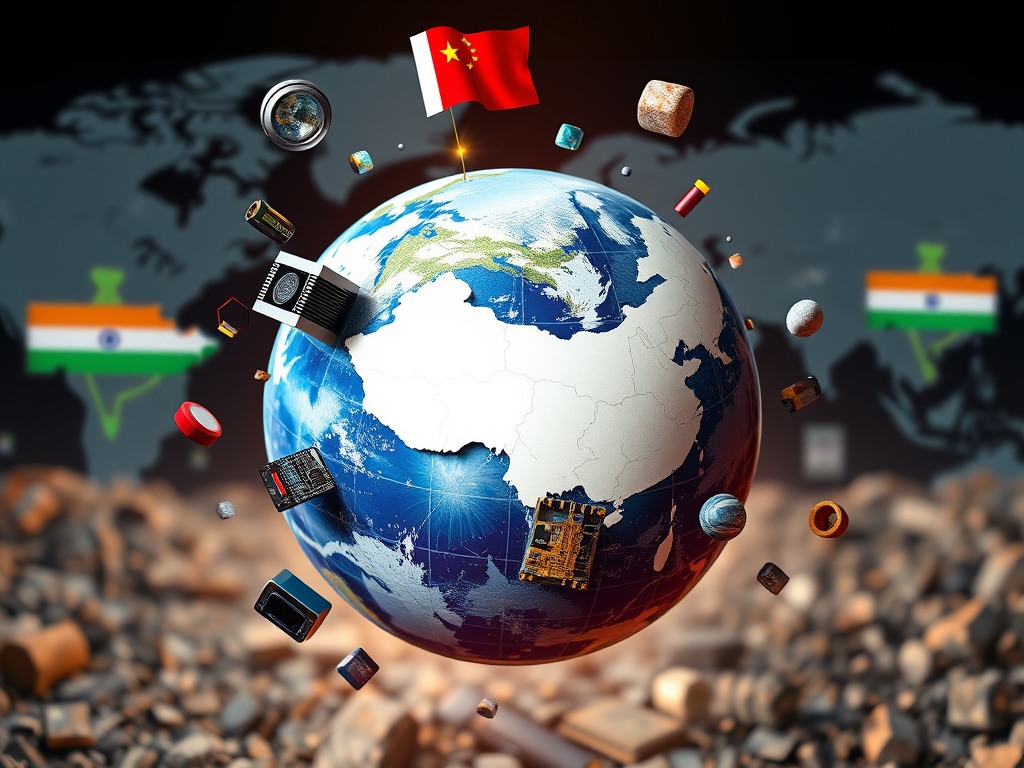
In a significant move with global implications, China has suspended exports of critical rare earth metals — including gallium, germanium, and antimony — materials that are essential for electronics, defense systems, and high-tech manufacturing. This development has triggered a strong response from nations around the world, particularly India, which is swiftly aligning its strategy to safeguard and grow its electronics industry.
🌍 Strategic Overview of Rare Earth Metal Dynamics
| Key Area | Details |
|---|---|
| Export Ban by China | Suspension of gallium, germanium, antimony exports |
| India’s Response | Exploring alternative sources and enhancing processing capability |
| Global Supply Chain Shift | Acceleration of diversification efforts post-COVID to reduce China dependence |
| Japan’s Strategy | Restarted portions of domestic mineral processing industry |
| U.S. Dependency | Still heavily reliant on China, especially for defense-grade materials |
| India-U.S. Trade Talks | Upcoming visit by US VP JD Vance expected to drive progress in bilateral trade agreements |
| India’s Electronics Growth | Production crossed ₹11 lakh crore; exports exceeded ₹3.25 lakh crore in the past decade |
| Government Support | ₹23,000 crore subsidy scheme to boost electronics component manufacturing |
| Strategic Importance | Increased trust in India due to stable foreign policy and proactive global engagement |
🇮🇳 India’s Strategic Response
Union IT Minister Ashwini Vaishnaw has outlined India’s multi-pronged approach in response to China’s export suspension:
1. 🔄 Alternative Sourcing
Indian electronics firms are proactively identifying new sources for gallium, germanium, and antimony. Countries like Australia, Vietnam, and Canada are seen as potential alternative suppliers.
2. 🤝 Government Support and Optimism
The Indian government is confident that the domestic sector can adapt. Dialogue with industry leaders and global partners is ongoing to ensure a steady supply of materials.
3. 🌐 Diversification of Supply Chains
The post-pandemic world has intensified the urgency to diversify global supply networks. India is positioning itself as a reliable alternative manufacturing hub for the world.
4. 🇮🇳🇺🇸 Bilateral Trade Momentum
Trade discussions between India and the U.S. are expected to accelerate, especially during the anticipated visit of U.S. Vice President JD Vance. These talks may unlock technology-sharing agreements and rare earth access.
5. 📈 Manufacturing Incentives
With schemes like the ₹23,000 crore incentive for electronics components, India is targeting rapid capacity-building and self-sufficiency in critical areas of the value chain.
6. 🏭 Boosting Processing Capabilities
While rare earth elements are globally available, China’s dominance lies in refining and processing. India plans to invest significantly to close this capability gap.
7. 🌎 Strengthening Global Alliances
India is reaching out to trusted international allies to form resource-sharing partnerships, improving access to critical materials while enhancing geopolitical resilience.
🚀 The Road Ahead
India’s response reflects a broader geoeconomic realignment, where national security, manufacturing growth, and supply chain resilience converge. The rare earth challenge is not just about materials—it’s about control, strategy, and sovereignty in a tech-driven world.
As the global electronics landscape undergoes transformation, India’s rapid and layered response might just redefine its role as a global manufacturing powerhouse.



 Glottis Limited
Leave a comment