
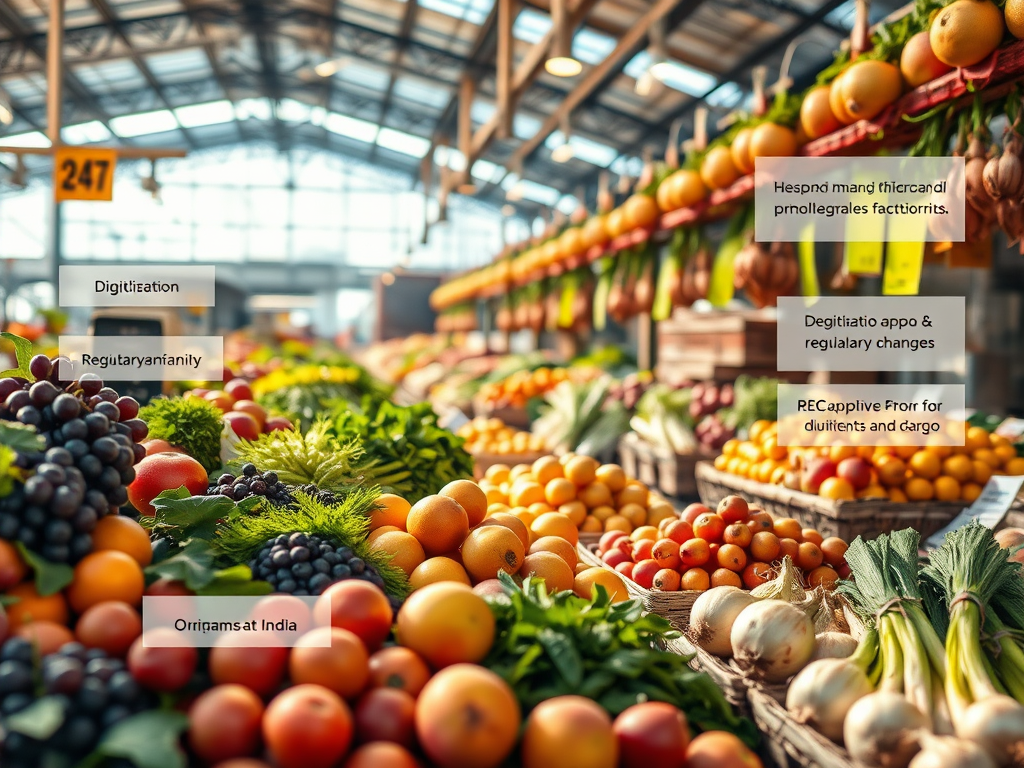
In a major push to strengthen its agricultural export capabilities, the Indian government has introduced a series of reforms aimed at simplifying and accelerating the movement of perishable goods, especially fruits and vegetables. These measures are expected to reduce costs, speed up processes, and position India as a stronger player in global agricultural trade.
Major Reforms to Enhance Agricultural Exports
1. Regulatory Reforms by CBIC
The Central Board of Indirect Taxes and Customs (CBIC) has simplified regulations related to air cargo movements. By cutting down bureaucratic hurdles, the CBIC seeks to ensure faster and smoother export procedures for perishable goods.
2. Elimination of Transhipment Fees
As of April 24, 2025, the fee for transhipment permits has been abolished, directly lowering logistics costs and reducing delays associated with freight movement across airports.
3. New Rules for Unit Load Devices (ULDs)
A harmonised process for the temporary import of Unit Load Devices (ULDs) has been introduced. Airlines and logistics service providers can now assume re-export responsibility for ULDs, significantly speeding up handling at air cargo complexes.
4. Adoption of the All-India Transhipment Bond
The government has allowed the use of a single transhipment bond across multiple customs locations, removing the need for exporters and airlines to create separate compliance documentation at every point.
5. Digitisation of Transhipment Processes
The transhipment application and permission processes have been digitised through ICEGATE, India’s electronic customs platform. Exporters can now apply and receive permissions online, eliminating the need for physical visits to customs offices.
Growing Opportunities in the Export Market
India’s fruit and vegetable exports have grown by over 5% to $3.39 billion during the first 11 months of the 2024–25 financial year, reflecting the country’s rising presence in global markets. The reforms are expected to further enhance this trend.
Major products such as grapes, mangoes, and onions continue to be in high demand internationally. Combined with infrastructure improvements like enhanced cold storage facilities and better packaging centers, India is well-positioned to expand its footprint in global agricultural trade.
Summary of Key Data
| Aspect | Details |
|---|---|
| Reform Authority | Central Board of Indirect Taxes and Customs (CBIC) |
| Key Reform Dates | Transhipment fee abolished on April 24, 2025 |
| Digitisation Platform | ICEGATE (for online transhipment applications) |
| Impact on Exports | Fruit and vegetable export revenues rose 5% to $3.39 billion (Apr–Feb 2025) |
| New Process for ULDs | Airlines/logistics agents responsible for ULD re-export |
| Simplification in Compliance | Single All-India Transhipment Bond adopted |
| Major Export Products | Grapes, mangoes, onions |
| Infrastructure Focus | Investment in cold storage, packaging, and logistics |
| Objective for Exporters | Faster shipments, reduced costs, expanded market reach |
Conclusion
The latest government reforms are a critical step toward making India a global powerhouse in fruit and vegetable exports. With regulatory simplifications, cost reductions, and investments in infrastructure, Indian exporters have a significant opportunity to grow their international footprint. Stakeholders are strongly encouraged to leverage these changes to enhance operational efficiency and maximize their global reach.




 Glottis Limited
Leave a comment