
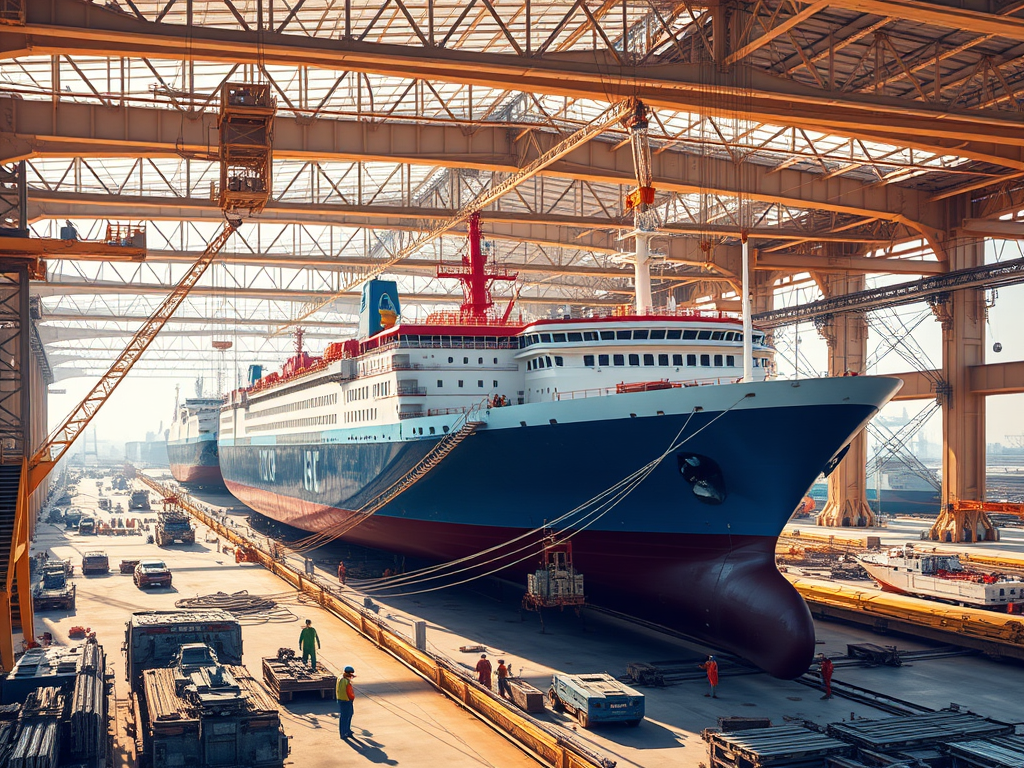
India is setting sail on an ambitious journey to transform its commercial shipbuilding industry. Currently ranked 20th globally with less than 1% market share, India aims to break into the top 10 shipbuilding nations by leveraging policy reforms, infrastructure investment, and local supply chain development. With global maritime trade expanding and geopolitical dynamics reshaping supply dependencies, India’s renewed focus comes at a crucial time.
Key Data: India’s Shipbuilding Ambition
| Factor | Details |
|---|---|
| Current Global Rank | 20th in commercial shipbuilding |
| Target Rank | Among top 10 by 2030 |
| Current Market Share | Less than 1% |
| Global Leader Share | China, Japan, South Korea — ~90% of global capacity |
| Strategic Framework | Maritime India Vision 2030 |
| Core Challenge | Weak local supply chain and heavy import dependence |
| Government Action | Policy reforms, incentives, regulatory easing |
| Support Areas | Infrastructure, skill development, domestic manufacturing |
Maritime India Vision 2030: The Strategic Blueprint
The Maritime India Vision 2030 forms the bedrock of India’s shipbuilding aspirations. It lays out a comprehensive strategy to:
- Enhance shipbuilding capacity in India’s public and private shipyards.
- Promote indigenous manufacturing of ship components.
- Attract domestic and international investment.
- Position India as a global hub for ship repair and maintenance.
This roadmap not only targets global competitiveness but also aligns with India’s broader “Aatmanirbhar Bharat” (self-reliant India) vision.
Why Supply Chain Localization Is the Game-Changer
A strong local supply chain is mission-critical for India’s shipbuilding evolution. Currently, shipbuilders are heavily reliant on imported components and systems, making them vulnerable to:
- Geopolitical disruptions
- Extended lead times
- High logistics and import duties
Key Focus Areas in Supply Chain Strengthening:
- Local Manufacturing of Components
Encouraging domestic production of propulsion systems, steel plates, navigation equipment, engines, and electronic components. - Financial Incentives
Offering subsidies, tax benefits, and grants to local manufacturers to scale production. - Industry-Government Collaboration
Joint ventures with international players for technology transfers and best practices. - Port & Logistics Infrastructure
Developing integrated shipbuilding clusters near ports for cost and operational efficiency. - Skill Development
Launching training and certification programs in welding, naval architecture, marine engineering, and design. - Regulatory Reforms
Streamlining approvals and reducing bureaucratic hurdles to attract private sector participation.
Strategic Benefits of Strengthening Shipbuilding and Its Ecosystem
- Job Creation: Thousands of new skilled and semi-skilled jobs across coastal regions.
- Export Opportunity: Potential to tap into the international demand for commercial and defense ships.
- Supply Chain Security: Reduced dependence on foreign suppliers for critical parts.
- Technological Advancement: Adoption of automation, digital design tools, and green shipbuilding practices.
Conclusion: India’s Maritime Leap Forward
India’s ambition to elevate its global rank in shipbuilding is not just a matter of capacity but a strategic imperative in the changing global trade order. By combining policy foresight with industrial collaboration, and supply chain localization with skill development, India is steering itself towards becoming a resilient and globally competitive shipbuilding nation.
As India sails ahead with its Maritime India Vision 2030, the development of an efficient, self-reliant supply chain will be the wind in its sails — enabling faster turnaround, reduced costs, and ultimately, a stronger presence in the global maritime economy.




 Glottis Limited
Leave a comment