
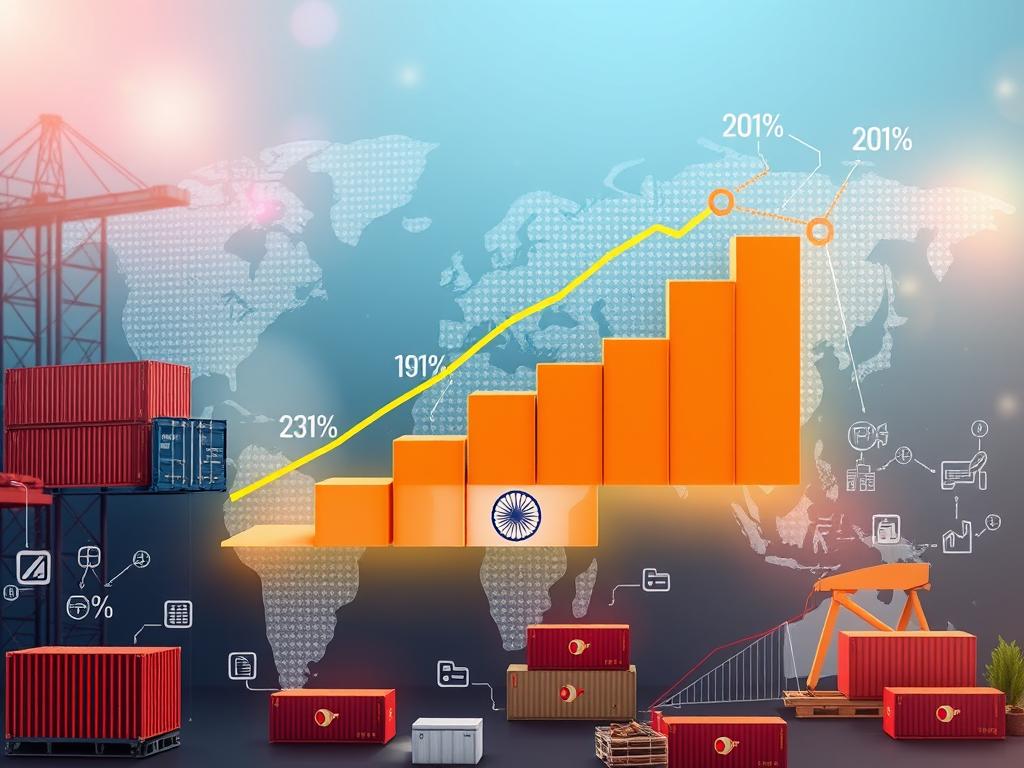
India’s export sector continues to gain global momentum, with the country’s share in global exports reaching 3% in 2023, a significant increase from 2.2% in 2010. This growth highlights the strength, adaptability, and strategic focus of India’s trade ecosystem in a rapidly evolving global economy.
Key Data on India’s Export Performance
| Key Point | Details |
|---|---|
| Global Export Share | Rose from 2.2% in 2010 to 3% in 2023 |
| Export Share Growth Rate | 6.3% annually – the fastest among major global economies |
| Exports Value (2009–10) | $274.8 billion |
| Exports Value (2022–23) | $776.3 billion |
| Exports Value (2024–25) | $825 billion |
| Top Growth Drivers | Booming services sector, resilient trade policies, strong manufacturing |
| Global Comparison | India outpaced the EU, China, and the US (growth rates: 3.9%–6.1%) |
| Sector Resilience | Indicates robust integration with global supply chains |
Global Context: India vs Major Economies
India’s consistent growth in exports is particularly notable when compared to major global economies. While the European Union, China, and the United States recorded slower export share increases between 3.9% and 6.1%, India surged ahead with a 6.3% annual growth, reinforcing its position as a fast-emerging export powerhouse.
🚀 Key Factors Driving Export Growth
| Factor | Description |
|---|---|
| Booming Services Sector | IT, software, and BPO exports have surged, especially to North America and Europe |
| Manufacturing Strength | “Make in India” and PLI schemes have boosted industrial and product manufacturing exports |
| Resilient Trade Policies | Streamlined trade regulations and agreements supported exporters through global disruptions |
| Supply Chain Integration | Better integration with global supply chains increased export agility and reach |
| Export Promotion Initiatives | SEZs, RoDTEP, EPCG, and other incentive programs improved export competitiveness |
| Product Diversity | Pharmaceuticals, textiles, machinery, electronics, and agricultural goods add to export resilience |
| Emerging Markets Demand | Rising demand from Africa, Southeast Asia, and Latin America diversifies India’s export markets |
| Technological Advancements | Digitalization and innovation enhance export efficiency and global competitiveness |
| Logistics & Infrastructure | Port upgrades, roadways, freight corridors improve delivery timelines and reduce logistics cost |
| Geopolitical Relations | Bilateral/multilateral ties with countries like UAE, Australia, and the EU enhance market access |
Conclusion
India’s rising share in global exports is not a result of short-term trends but a reflection of long-term structural improvements, targeted government policies, and a thriving private sector. As the country continues to push the boundaries in services, manufacturing, and global partnerships, its trajectory suggests an even stronger presence in international trade in the coming years.
This export story is not just about numbers—it’s about India’s emergence as a reliable, competitive, and diversified global trade partner.


 Glottis Limited
Leave a comment