
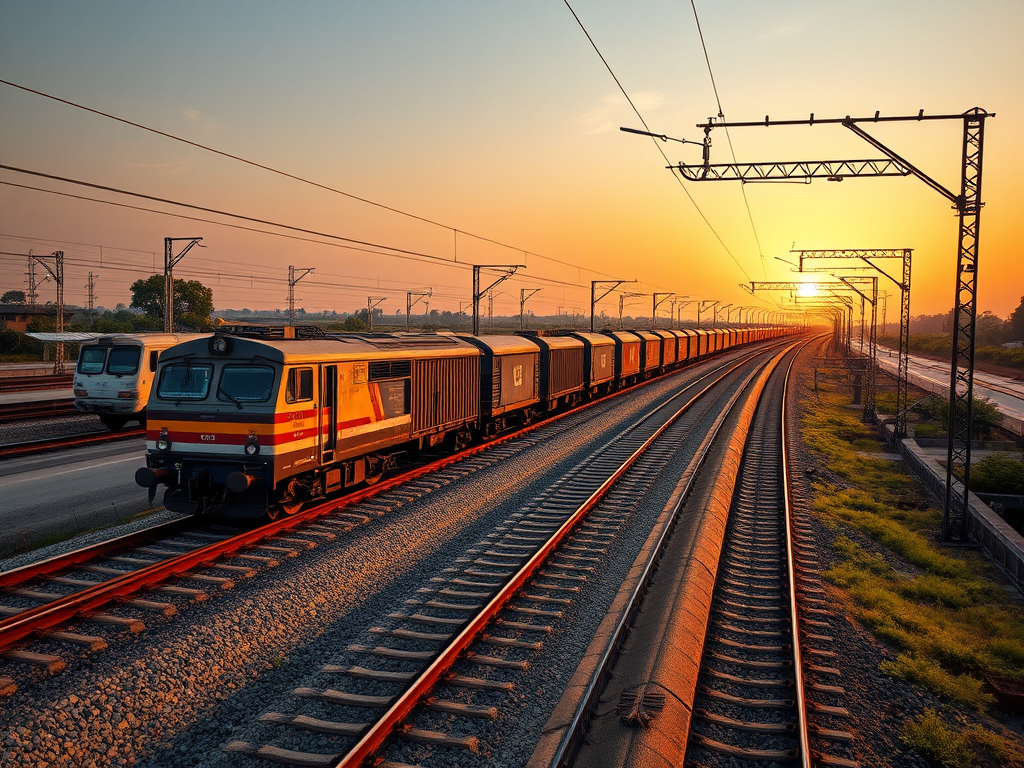
India’s ambitious Dedicated Freight Corridor (DFC) project is close to full realization, marking a transformative shift in the country’s freight logistics and rail infrastructure. With most of the network commissioned and operations rapidly scaling up, DFCs are poised to redefine freight efficiency, decongest passenger routes, and bring global standards to Indian rail logistics.
Overview of the DFC Project
The Dedicated Freight Corridor Corporation of India Limited (DFCCIL) is spearheading this mega initiative. The total planned network of 2,843 km, comprising the Eastern and Western corridors, is now 96.4% complete, making DFC one of the most advanced freight-specific rail networks in the world.
Key Highlights at a Glance
| Aspect | Details |
|---|---|
| Total DFC Network | 2,843 km |
| Completion Rate | 96.4% |
| Eastern DFC | 1,337 km – 100% commissioned |
| Western DFC | 1,506 km – 93.2% commissioned |
| Share in Rail Freight | >13% of India’s total railway freight on just 4% of the network |
| Daily Train Movement | FY23: 170 trains → FY25: 356 trains |
| Axle Load Capacity | 25 tonnes (upgradable to 32.5 tonnes) vs. 22.9 tonnes on conventional lines |
| Average Speed | DFC: 50–60 kmph (potential 100 kmph) vs. 25–30 kmph on conventional lines |
Engineering and Efficiency Upgrades
The DFC is built with state-of-the-art specifications:
- Heavier Axle Loads: Designed for 25 tonnes, upgradable to 32.5 tonnes—allowing heavier rakes and longer trains.
- High-Speed Tracks: Freight movement at 2x the speed of traditional Indian Railways, ensuring faster delivery.
- Infrastructure Longevity: Stronger civil structures to withstand heavier and faster trains.
Operational Impact and Traffic Surge
Despite being just a fraction of the total railway network, the DFC is already carrying over 13% of total freight, validating its strategic importance.
- Freight train operations have doubled in just two years.
- Decongestion of regular rail routes has enhanced punctuality and efficiency for passenger trains.
- The dedicated nature of DFC ensures no interference from passenger traffic, leading to uninterrupted freight movement.
Shift Toward Advanced Maintenance
Now that the construction phase is nearly over, DFCCIL is focusing on smart maintenance strategies:
- Technologies adopted: Rail grinding, ultrasonic flaw detection, and autonomous inspection systems.
- Future-readiness: Plans for a wayside monitoring system to continuously assess rolling stock conditions in real time.
Vision for the Future
DFCCIL aims to be India’s benchmark in heavy haul freight and asset management, with goals to:
- Create an integrated maintenance ecosystem without legacy limitations.
- Pioneer technology-led operations that can be scaled across future corridors.
- Lead India’s modal shift from road to rail, lowering emissions and improving supply chain resilience.
Conclusion
As India looks to boost its logistics efficiency and meet ambitious economic targets, the DFC stands out as a model of modern rail infrastructure. With innovation, capacity, and operational focus, DFCCIL is not just building tracks—it’s laying the foundation for a faster, cleaner, and smarter freight movement future.




 Glottis Limited
Leave a comment