
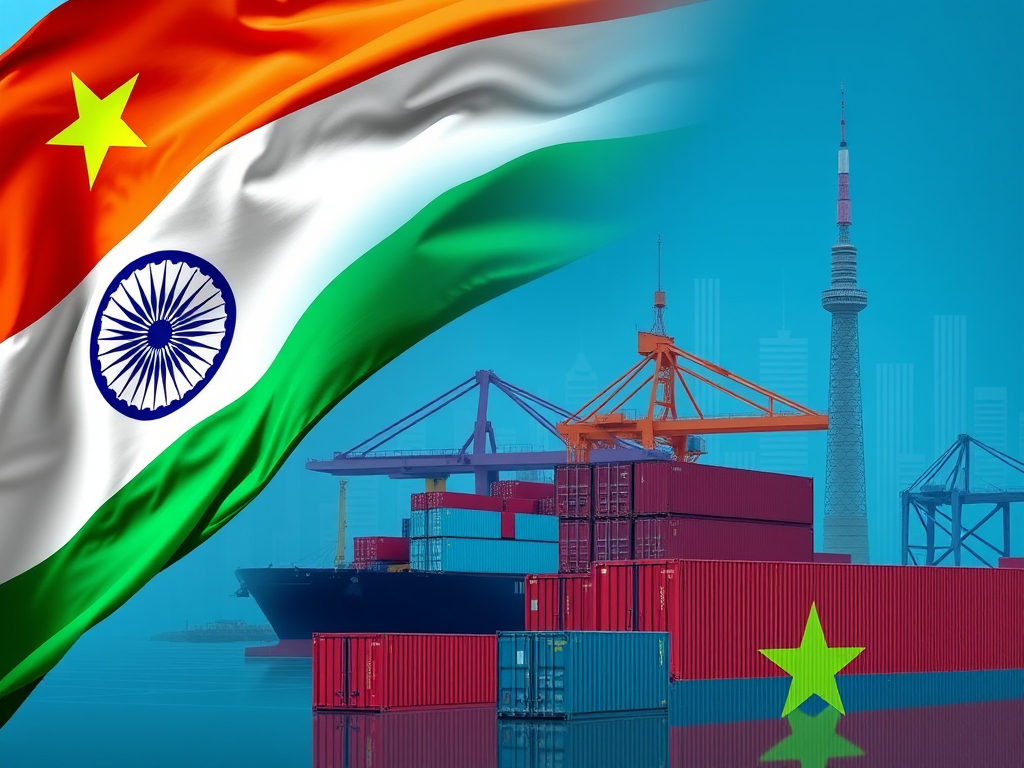
India could potentially lose up to $5 billion in exports to Vietnam if it fails to negotiate a favorable trade deal with the United States, according to recent trade analysis. However, deeper data reveals that the real exposure is limited, with only a narrow segment of exports facing overlapping competition with Vietnam.
This development comes amid shifting global trade alliances and the increasing influence of regional partnerships such as the RCEP, where Vietnam is a strong participant, potentially gaining a cost advantage through preferential tariffs.
Key Trade Data: India vs. Vietnam Export Exposure to U.S.
| Metric | Value / Insight |
|---|---|
| India’s total exports to the U.S. (2023) | $76 billion |
| Overlapping export volume with Vietnam | $5.4 billion |
| Products with overlapping export value > $5 million | 161 products |
| Total U.S. trade in these 161 items | $22 billion |
| India’s potential high-risk export loss | Up to $5 billion (theoretical maximum) |
| Realistic exposure in key competing products | ~$353 million |
| Vietnam’s competitive threat | Moderate, limited to select segments |
Key Observations
1. Low Overlap Risk
While Vietnam is gaining prominence in global manufacturing and exports, only $5.4 billion of India’s U.S.-bound exports overlap with Vietnam’s strengths. Out of this, the direct competition where Vietnam has a significant advantage is estimated at just $353 million, indicating that fears of a large-scale erosion may be overblown.
2. India Exports More in Shared Segments
For the 161 common products exported by both countries to the U.S., India’s export volumes exceed those of Vietnam, showcasing India’s competitiveness in these areas.
3. Tariff Risks & Trade Diversion
Without a U.S. trade deal that reduces tariffs, Vietnam may gain a pricing edge through existing or future trade partnerships. This can lead to trade diversion, where buyers shift sourcing to Vietnam due to cost benefits.
4. Strategic Implication for India
India may need to:
- Accelerate bilateral trade negotiations with the U.S.
- Strengthen infrastructure and export incentives for overlapping products.
- Expand presence in non-overlapping sectors to diversify its trade resilience.
Global Trade Context – Major Economies & Trade Flows
To understand India’s positioning better, here is a snapshot of how major economies trade:
| Country/Region | Major Exports | Major Imports |
|---|---|---|
| United States | Electronics, aircraft, vehicles, pharma | Oil, electronics, machinery |
| China | Electronics, machinery, furniture | Crude oil, metals, agri-products |
| European Union | Vehicles, chemicals, machinery | Energy, data equipment, agri-goods |
| Japan | Vehicles, electronics, robotics | Oil, food products |
| Vietnam | Electronics, textiles, footwear, furniture | Machinery, electronics, chemicals |
| India | Pharmaceuticals, textiles, engineering goods | Crude oil, electronics, chemicals |
Notable Trade Agreements Influencing Global Trade
| Agreement | Participants | Impact |
|---|---|---|
| RCEP | ASEAN, China, Japan, South Korea, Australia, New Zealand | Boosts intra-Asia trade, favors low-tariff exporters |
| USMCA (NAFTA 2.0) | U.S., Canada, Mexico | Modernized North American trade framework |
| EU Trade Pacts | EU nations with several countries | Grants preferential market access across Europe |
| India’s Bilateral Talks | UK, UAE, Australia, U.S. (in progress) | Aimed at securing tariff relief and diversifying markets |
Conclusion: Cautious Optimism for India
While a no-deal scenario with the U.S. could give Vietnam a marginal advantage, India’s exposure is limited. The real risk lies in select product categories worth about $353 million, not the entire $5 billion theoretical ceiling.
India’s competitive edge in quality, scale, and sector diversity remains strong. The key lies in leveraging bilateral negotiations, enhancing trade facilitation, and focusing on sectors with unique advantages to stay ahead in the evolving global trade arena.



 Glottis Limited
Leave a comment