
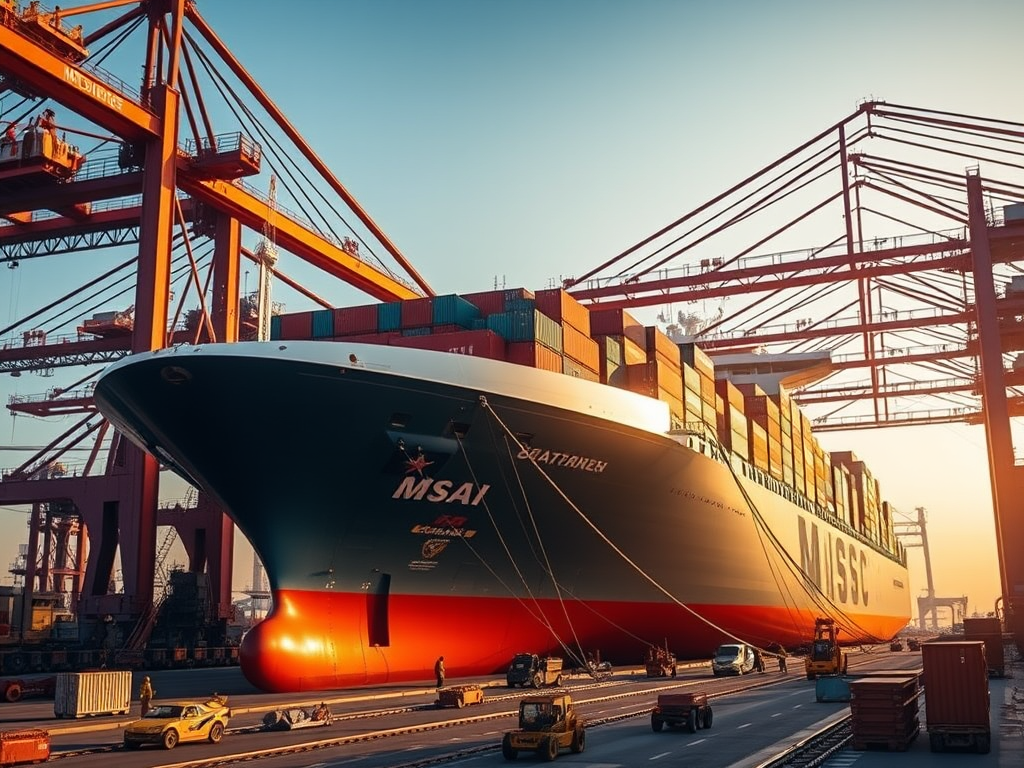
Mediterranean Shipping Company (MSC), the world’s largest container shipping line by capacity, continues to reinforce its market dominance through strategic vessel orders and fleet expansion, even as the global shipping industry navigates a complex environment of shifting demand and logistical disruptions.
Strategic Orders: A Bold Capacity Play
In a significant development, MSC has placed orders for six ultra-large container vessels (ULCVs) with a capacity of 22,000 TEUs each. Of these, four vessels will be built by Shanghai Waigaoqiao Shipbuilding, and two by Hengli Heavy Industries. These ships are among the largest in the world, reflecting MSC’s long-term vision to optimize scale and reduce cost per container on high-volume trade routes.
Additionally, MSC has upsized its previous vessel order, converting six ships initially planned at a smaller capacity into 19,000 TEU vessels, reaffirming its aggressive expansion strategy in response to evolving global trade patterns.
Key Data Table: MSC’s Latest Fleet Expansion
| Metric | Details |
|---|---|
| New Vessel Orders | 6 vessels of 22,000 TEU capacity |
| Shipyards Involved | 4 ships from Shanghai Waigaoqiao, 2 from Hengli Heavy Industries |
| Order Upsizing | 6 vessels upgraded to 19,000 TEU capacity |
| Vessel Type | Ultra-Large Container Vessels (ULCVs) |
| Strategic Objective | Market leadership, economies of scale, operational efficiency |
| Industry Context | High freight volatility, port congestion easing, demand recovery uncertain |
Industry Context: Navigating Shifting Tides
MSC’s bold moves come at a time when the container shipping market remains in flux, with overcapacity concerns, fluctuating demand, and ongoing disruptions such as Red Sea rerouting, port bottlenecks, and decarbonization pressures. Rather than taking a conservative stance, MSC is doubling down on capacity dominance, leveraging its strong financial position and operational scale.
These new orders also reflect MSC’s anticipation of long-term growth, particularly on major East-West and Asia-Europe routes. By investing in newer, larger vessels, MSC aims to reduce unit costs and enhance fuel efficiency, positioning itself ahead of peers in sustainability and operational resilience.
Strategic Implications
MSC’s actions send a clear signal to the industry: scale remains a key differentiator. While other carriers adjust strategies due to softening rates or geopolitical risks, MSC is betting on the inevitability of global trade recovery and is positioning its fleet accordingly.
These moves also reinforce MSC’s continued lead in the Alphaliner global carrier rankings, a position it has held since overtaking Maersk Line.
Conclusion
As the maritime industry watches closely, MSC’s expansion signals a continued race for capacity and efficiency. With its eyes on the horizon, MSC is not merely reacting to the current market—but shaping its future.



 Glottis Limited
Leave a comment