
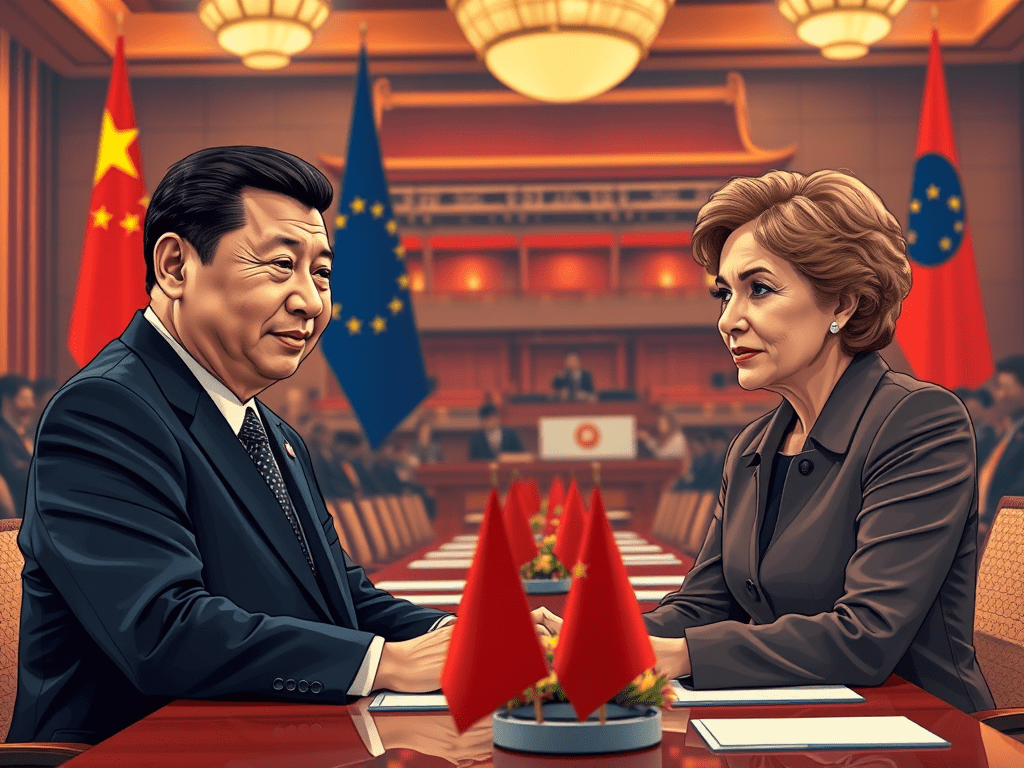
The EU-China Summit, held in Beijing, marks a crucial diplomatic engagement between two of the world’s most influential economic powers. Amid growing global uncertainty and escalating geopolitical tensions, the summit brings into focus key issues straining the EU-China relationship — from trade conflicts to political mistrust, and the ongoing war in Ukraine.
A Summit Overshadowed by Strategic Mistrust
Although the summit was expected to ease friction and rebuild diplomatic trust, the atmosphere remains cautious. With Chinese President Xi Jinping attending after declining an earlier invitation to Brussels, expectations are mixed. The European Commission President Ursula von der Leyen stressed the need for a “mutually beneficial cooperation,” while acknowledging the complexities surrounding the dialogue.
The summit arrives at a time when relations between the EU and China are at their most delicate in recent history.
Key Themes of the EU-China Summit 2025
| Topic | Details |
|---|---|
| Summit Context | Held in Beijing, the summit addresses global trade, political ties, and the Ukraine war amid strained EU-China relations. |
| Notable Attendance | President Xi Jinping confirmed his presence after previously rejecting an EU-hosted summit in Brussels. |
| Trade Relations | Trade tensions intensify over tariffs on EVs, and retaliatory measures on medical devices, rare earths, and other sensitive goods. |
| Strategic Mistrust | Mutual skepticism persists, fueled by EU sanctions on Chinese banks linked to Russia and China’s support for Moscow. |
| Russia-Ukraine War | The war remains a core issue, with the EU urging China to adopt a more neutral or critical stance toward Russia. |
| Sanctions & Reactions | EU imposed financial restrictions on Chinese institutions over support to Russia; China responded with trade countermeasures. |
| Statements from Leaders | EU officials stressed openness to frank discussions; Chinese side emphasized the need to rebalance bilateral relations. |
| Historical Tensions | Ties have eroded over years, marked by Xi’s recent presence at Russian events, contrasting with coolness towards prior EU invites. |
| Future Cooperation | Low expectations but emphasis on long-term cooperation and rebuilding trust in strategic sectors and green technology. |
Broader Implications
- Global Trade Realignment: With China and the EU both facing economic headwinds, there is pressure to recalibrate their commercial engagement, especially in green energy, electric vehicles, and high-tech sectors.
- Security & Diplomacy: The summit underscores how global conflicts, like the Russia-Ukraine war, directly impact bilateral diplomacy, influencing sanctions, financial linkages, and trade routes.
- Economic Interdependence vs. Political Divergence: While economically intertwined, EU and China diverge significantly on governance, transparency, and strategic influence — driving continued friction.
Conclusion
The EU-China Summit 2025 reflects a critical juncture in global diplomacy. Despite low expectations for immediate breakthroughs, the fact that such high-level talks continue underscores the mutual recognition of interdependence. The challenge ahead lies in bridging the divide between strategic competition and constructive cooperation.
As both sides navigate complex global challenges, the summit may yet serve as a platform for cautious recalibration — if not reconciliation.

 Glottis Limited
Leave a comment