
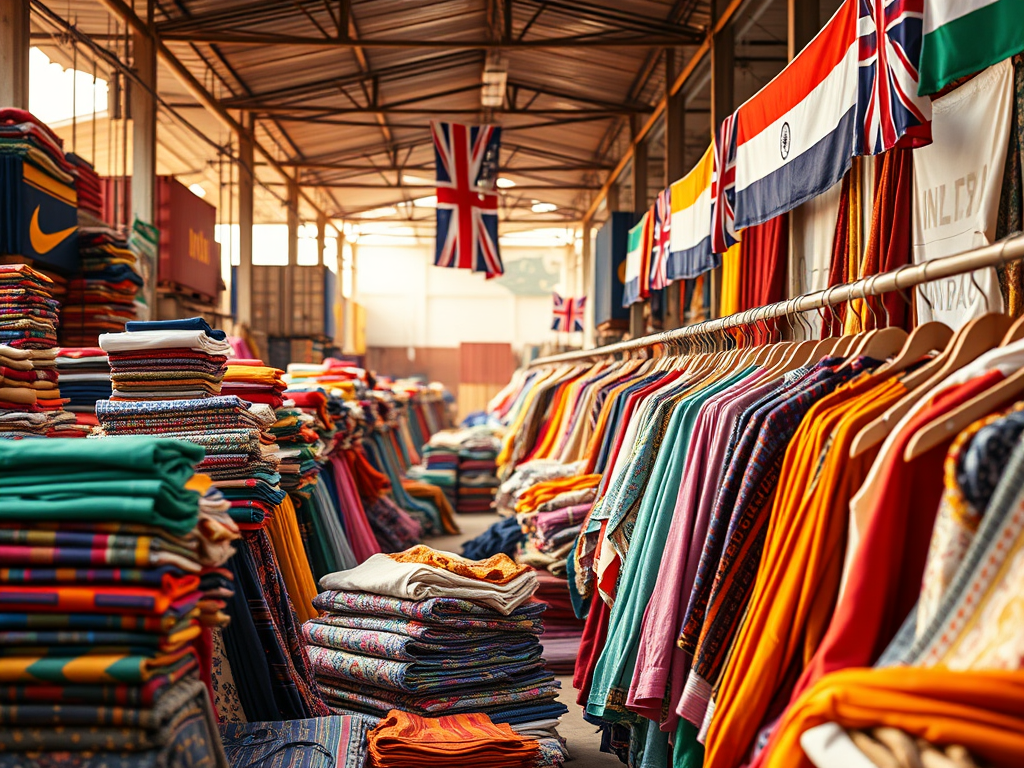
The proposed India-UK Free Trade Agreement (FTA) brings long-awaited tariff relief to India’s textile and garment industry. With duties ranging from 4% to 12% being eliminated, the deal targets revitalizing India’s textile exports, especially Ready-Made Garments (RMG). However, despite this opportunity, India faces an uphill task due to entrenched global competition, structural inefficiencies, and policy challenges.
Highlights of the India-UK Textile Trade Deal
| Aspect | Details |
|---|---|
| Tariff Elimination | Duties on Indian textiles (4–12%) to be removed under the FTA |
| India’s UK RMG Share | Only 6% of UK’s RMG imports come from India |
| Target Export Growth | India aims for a 30–40% increase in UK RMG exports post-FTA |
| Market Share Trend | Declined from 26% (2000) to 21% (2003) due to lack of FTAs |
| Structural Barrier | Inverted duty structure — higher taxes on raw materials than finished goods |
| FTA Lessons | Prior FTAs (e.g., Indo-Japan) failed to deliver expected textile export growth |
India’s Competitive Position in the UK Textile Market
Despite the tariff relief under the new FTA, India lags behind key rivals that already enjoy stronger access and ecosystem advantages:
| Country | UK RMG Import Share | Key Advantages |
|---|---|---|
| China | ~25% | Scale, established supply chain, low cost |
| Bangladesh | ~20% | Zero-duty access via LDC status, large-scale production |
| Vietnam | ~10–12% (estimated) | FTA-driven zero-duty access, efficient manufacturing ecosystem |
| Turkey | ~7–8% (estimated) | Proximity to Europe, zero-duty access, advanced textile technology |
| Malaysia/South Korea | Lower than top 4 | Trade agreements and strategic investments in textile manufacturing |
Key Challenges for India
- Inverted Duty Structure: Taxing raw materials more than finished goods discourages competitiveness and innovation.
- Fragmented Supply Chain: Lack of vertically integrated clusters weakens India’s delivery timelines and cost efficiency.
- FTA Utilization Gaps: Past trade deals (e.g., with Japan) underperformed due to poor awareness and ecosystem readiness.
- Stiff Competition: Competing countries have entrenched themselves with better logistics, infrastructure, and trade diplomacy.
- Limited Value-Addition: Focus on low-value segments; India must pivot to high-end, functional, and technical textiles.
What India Must Do to Win
| Strategy | Action Points |
|---|---|
| Supply Chain Overhaul | Invest in integrated clusters, reduce logistics costs |
| FTA Awareness & Utilization | Educate exporters on trade benefits, simplify documentation |
| Policy Correction | Correct inverted duty structure; incentivize raw material sourcing |
| Innovation Push | Focus on technical textiles, design-led garments, and sustainable fashion |
| Export Diversification | Expand to mid/high-value categories to improve margins and compete on value |
| Marketing Support | Build Indian textile brand visibility in the UK through trade shows and campaigns |
Conclusion
The India-UK textile trade deal presents a critical window of opportunity, especially for RMG and labor-intensive sectors. However, tariff elimination alone is not a silver bullet. India must confront long-standing challenges, invest in infrastructure and innovation, and strengthen its export strategy to reclaim its position in global textile trade. The world is watching—whether India sews success or misses the stitch depends on execution.




 Glottis Limited
Leave a comment