
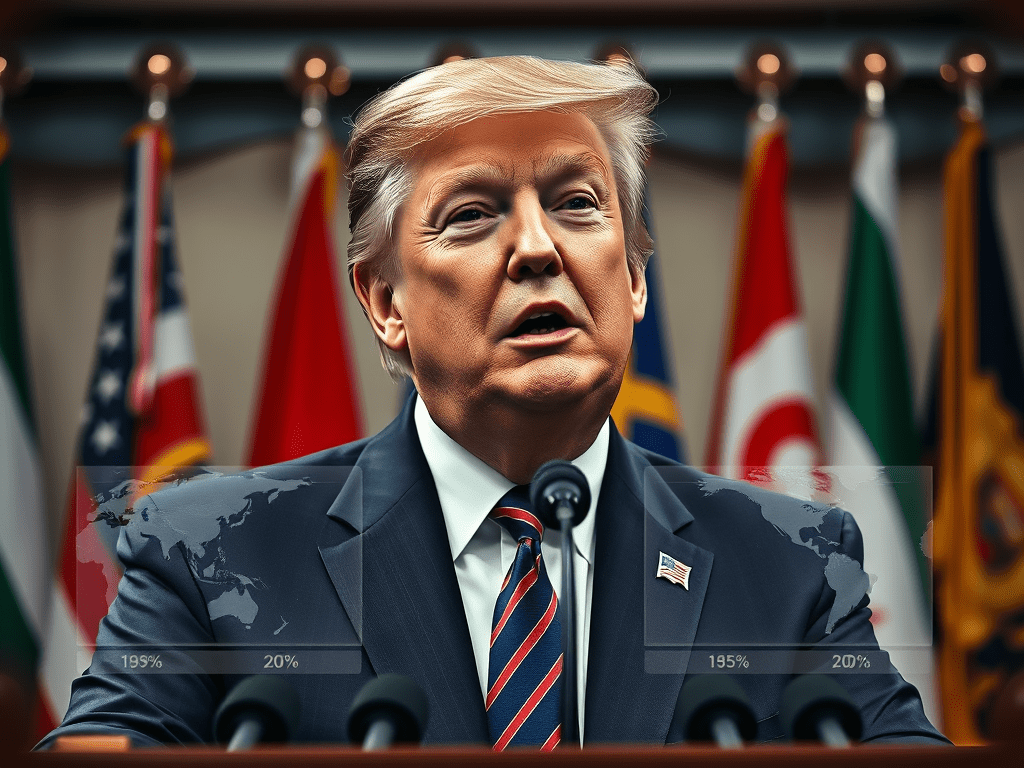
Former President Donald Trump has announced a sweeping overhaul of U.S. trade policy, calling for a global baseline tariff targeting countries without comprehensive U.S. trade agreements. The plan, taking effect August 1, 2025, represents one of the most significant shifts in American trade posture in decades.
Key Points of the Announcement
- Global Baseline Tariff: Imports from countries lacking a bilateral trade agreement with the U.S. will face a new “world tariff,” set at 15% to 20%—an increase from the 10% baseline mooted earlier in 2025.
- Policy Simplification: The stated goal is to simplify trade rather than penalize specific countries, with Trump emphasizing, “It’s impractical to negotiate 200 separate deals,” making this blanket tariff a pragmatic alternative.
- New Trade Agreement Deadline: All countries have until August 1, 2025, to finalize new deals with the U.S.; after that, the new tariffs automatically apply unless a special exemption is negotiated.
- Recent Trade Deals: Major agreements were recently secured with Japan, Indonesia, and the Philippines, setting tariffs at 15% for Japan, 19% for Indonesia and the Philippines, and arranging large-scale investments and market access provisions.
- EU Deal and Ongoing Talks with China: A key U.S.-EU deal imposes a 15% tariff on most EU goods, alongside a pledge of $750 billion in U.S. energy purchases and $600 billion in U.S. investments from Europe. U.S.-China negotiations remain ongoing, with a provisional extension of a tariff truce until mid-August, after which triple-digit tariffs could be imposed if no deal is reached.
- Domestic Manufacturing Focus: The Trump administration is also doubling down on domestic steel and aluminum production by raising tariffs on those imports to 50% for non-exempt countries, further squeezing foreign producers while supporting U.S. industry.
- Negotiated Exceptions and Specifics: Some countries have secured lower rates or unique provisions through last-minute deals. However, many—especially smaller or less developed economies—risk higher tariffs and face tough new terms for U.S. market access.
Key Data Table
The Broader Impact
Trump’s approach consolidates tariffs into a standardized “world tariff,” moving away from decades of trade liberalization. The strategy gives the White House leverage but also raises the specter of retaliatory tariffs and turbulence in global supply chains. Major trading partners rushed to the negotiating table ahead of the deadline, but dozens of nations are bracing for costly new barriers.
The final rates—15% to 20% for most of the world—are the highest U.S. baseline tariffs instituted in nearly a century, signaling a dramatic pivot to economic nationalism and a fundamental reset of global trade norms.
Note: All figures reflect the latest available announcements as of July 29, 2025. New developments may emerge as negotiations continue and tariff policies are implemented.



 Glottis Limited
Leave a comment