
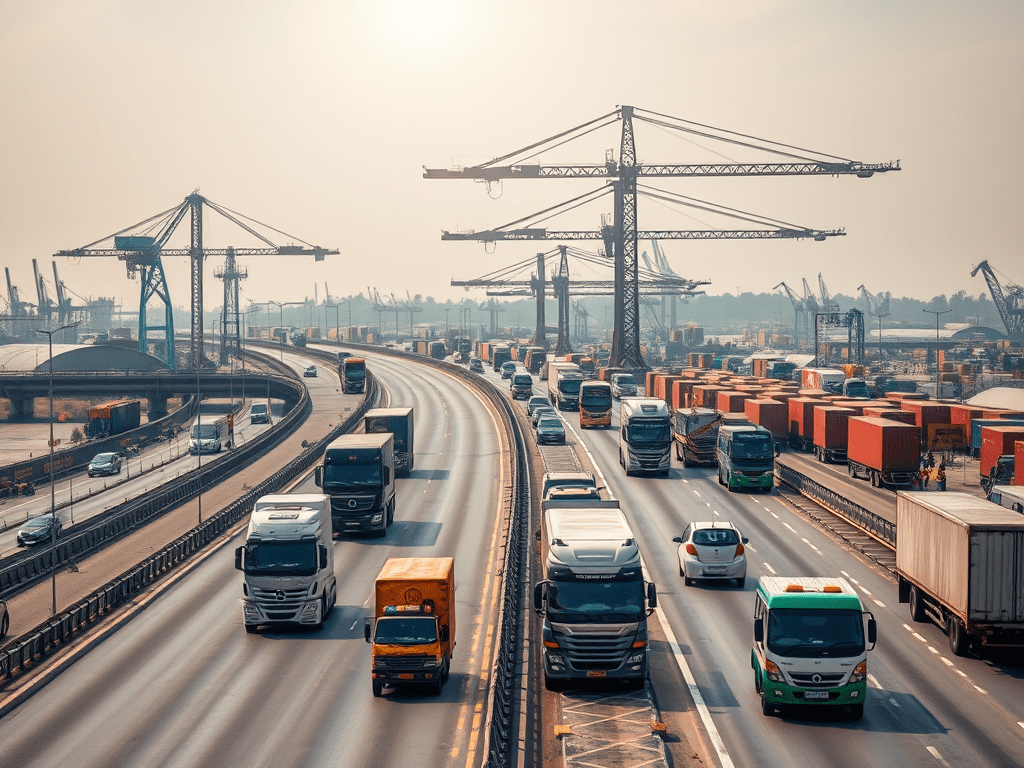
India is making significant strides in logistics and infrastructure development with targeted reforms and investment. The Union Minister for Road Transport and Highways, Nitin Gadkari, recently announced that India aims to reduce its logistics cost to below 10% of GDP by December 2025. Achieving this benchmark is expected to enhance India’s global competitiveness and improve the efficiency of its supply chain network.
Key Developments in India’s Logistics Sector
- Ambitious Cost Reduction: India’s logistics cost currently stands between the U.S. (12%) and China (8%). Lowering this figure will improve India’s attractiveness as a manufacturing and export hub.
- Green Transportation Transition: The government is actively promoting electric mobility and biofuel adoption, emphasizing ethanol and hydrogen blends to decrease reliance on fossil fuels.
- Major Infrastructure Projects: The foundation stones for 27 new road projects and the inauguration of two more in Andhra Pradesh (worth approximately ₹5,235 crore) underscore the focus on transportation network expansion.
- Sea Port Expansion: Investment in multi-modal logistics hubs and sea ports along Andhra Pradesh’s 1,000-km coastline aims to facilitate efficient cargo movement and trade.
- Enhanced Road Safety Measures: With Andhra Pradesh facing high road accident rates, road safety audits and district-level interventions are being prioritized.
- Expansion of Highway Network: Projects such as the Hyderabad-Vijayawada greenfield highway are bolstering connectivity and reducing travel time.
- Emphasis on Core Infrastructure: Highlighting global precedents like the U.S., there is renewed recognition of the role that world-class water, power, transport, and communications infrastructure play in driving national prosperity.
Table: Key Factors Affecting Logistics Cost and Their Implications
| Factor | Implication |
|---|---|
| Infrastructure Development | Enhances transport efficiency; reduces transit time and fuel consumption. |
| Technology Integration | Optimizes routes and inventory; reduces manual errors and operational costs. |
| Sustainable Practices | Lowers long-term fuel costs; supports environmental goals. |
| Multi-Modal Transportation | Offers more flexible and cost-effective logistics solutions; minimizes bottlenecks. |
| Supply Chain Management | Reduces excess inventory; ensures better resource allocation and responsiveness to demand changes. |
| Regulatory Support | Streamlines processes and reduces compliance costs; promotes industry growth through incentives. |
| Collaboration and Partnerships | Secures better rates; enables integrated services and service reliability. |
| Training and Workforce Development | Ensures skilled operation of advanced systems; improves productivity and safety. |
| Economies of Scale | Decreases per-unit shipping costs; allows for bulk negotiation and operational efficiency. |
Implications for India’s Economic Competitiveness
Implementing these strategic measures and key factors will significantly improve the country’s logistical performance, making India an even more compelling destination for global manufacturing and trade. Efficient logistics will not only reduce operational costs for businesses but also enhance the overall economic environment through improved connectivity, sustainability, and innovation.


 Glottis Limited
Leave a comment