
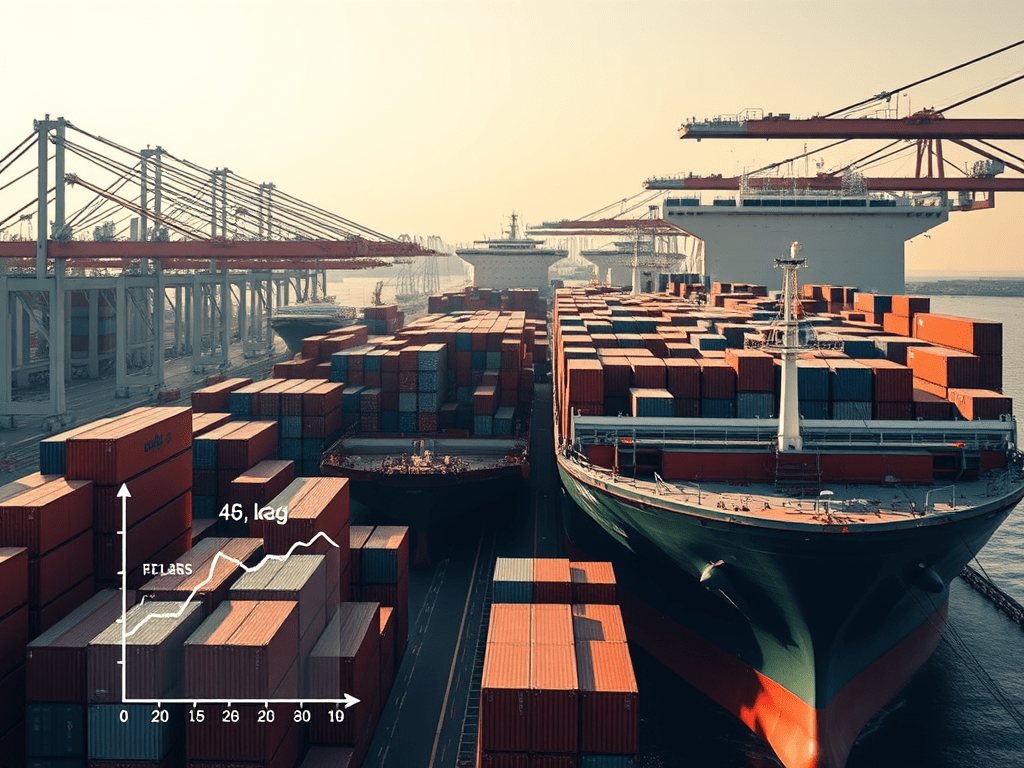
The global container shipping market is sending conflicting signals in mid-2025. While time charter rates remain at historically high levels (outside the pandemic surge), spot rates have been on a steady decline for nine consecutive weeks. This divergence reflects an industry grappling with strong charter market sentiment but weaker freight market fundamentals.
Stability in Time Charter Rates vs. Weak Spot Market
The Containership Timecharter Rate Index currently stands at 198 points, indicating a healthy and stable charter market. However, the Shanghai Containerised Freight Index (SCFI) fell by 4% week-on-week and is now 60% below last summer’s highs, showing a continued erosion in spot freight rates.
Divergent Carrier Outlooks
Major liner companies are adjusting their financial forecasts in opposite directions:
- Maersk has raised its full-year EBITDA forecast to $8–9.5 billion, citing stronger-than-expected demand.
- Ocean Network Express (ONE) has cut its forecast by $400 million, blaming geopolitical tensions and a softer macroeconomic environment.
Overcapacity Threat Looms
Global shipping fleet capacity has expanded to 145 points (baseline 100 in 2019), but container shipping demand has only reached 113 points. Analysts expect the excess supply to persist until 2029, placing sustained downward pressure on freight rates despite seasonal market improvements.
Market Activity Remains Firm
Despite the seasonal slowdown in demand, the charter market remains “firm and healthy”, with consistent activity across vessel sizes and segments. Still, carriers face a delicate balancing act between filling excess capacity and maintaining rate stability.
Key Data – Container Shipping Market Snapshot
| Metric | Current Status | Change / Comparison |
|---|---|---|
| Containership Timecharter Rate Index | 198 points | Stable, historically high (ex-COVID) |
| Shanghai Containerised Freight Index | Down 4% WoW | 60% lower vs. summer 2024 peak |
| Maersk 2025 EBITDA Forecast | $8–9.5 billion | Raised from previous estimate |
| ONE 2025 EBITDA Forecast | Cut by $400 million | Due to geopolitical & economic headwinds |
| Global Fleet Capacity Index | 145 points | From baseline 100 in 2019 |
| Container Demand Index | 113 points | Demand lagging supply |
| Overcapacity Outlook | Until 2029 | Persistent rate pressure expected |
Outlook
The container shipping industry is entering a prolonged phase of overcapacity, which is expected to test carriers’ ability to sustain freight rates. While the charter market’s resilience is providing temporary relief, persistent supply-demand imbalances may keep spot rates subdued for years. Strategic capacity management and market diversification will be crucial for liner profitability in this evolving landscape.




 Glottis Limited
Leave a comment