
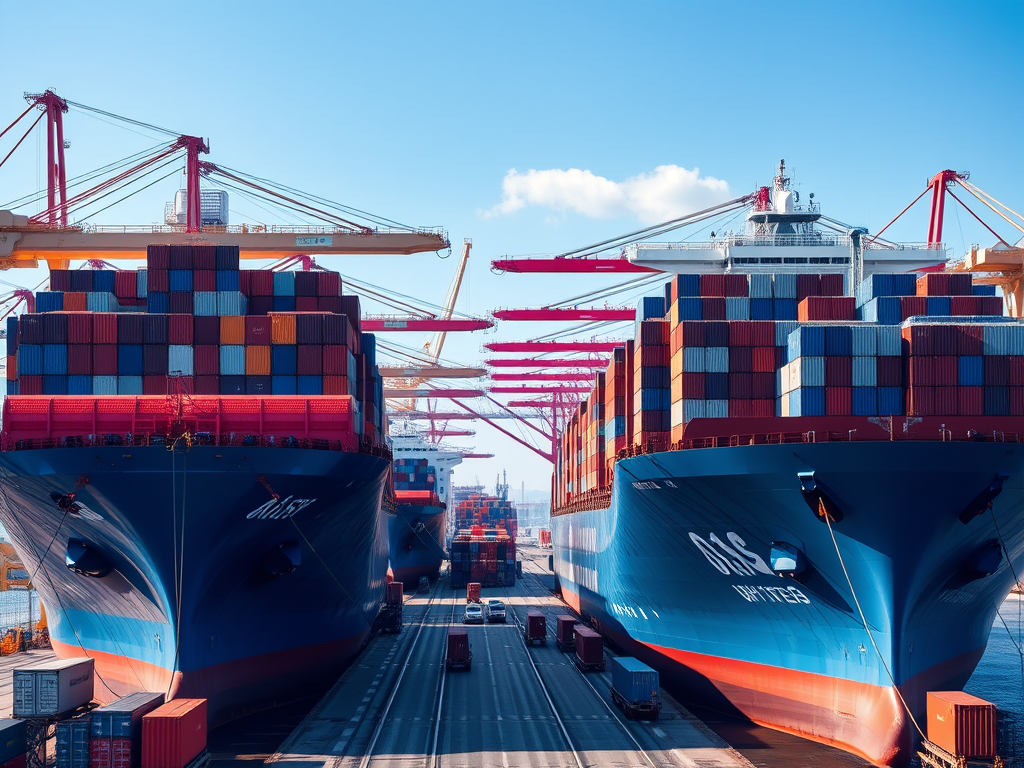
Asia remains at the heart of global container shipping, home to some of the world’s most influential carriers. These companies dominate the industry with their massive fleets, expanding TEU capacities, and continued investments in modern vessels and sustainable practices. Below is a snapshot of the top Asian container shipping companies and their market positions:
Key Data: Top Asian Container Shipping Companies
| Company | TEU Capacity | Market Share | Fleet Size | Ships on Order |
|---|---|---|---|---|
| COSCO SHIPPING LINES | 3,447,635 TEU | 10.6% | 534 | 71 |
| OCEAN NETWORK EXPRESS (ONE) | 2,102,829 TEU | 6.4% | 274 | 48 |
| EVERGREEN MARINE CORPORATION | 1,874,734 TEU | 5.7% | 232 | 48 |
| HMM | 941,019 TEU | 2.9% | 86 | 7 |
| YANG MING | 726,031 TEU | 2.2% | 101 | 18 |
| WAN HAI LINES | 550,947 TEU | 1.7% | 114 | 32 |
| PACIFIC INTERNATIONAL LINES (PIL) | 432,070 TEU | 1.3% | 98 | 20 |
| SITC | 189,481 TEU | – | 122 | 14 |
| X-PRESS FEEDERS | 186,702 TEU | – | 103 | 10 |
| IRISL GROUP | 144,470 TEU | – | 32 | 0 |
Key Insights
- Asia’s Dominance: Asian carriers collectively command a significant portion of global container shipping, driving trade flows between Asia, Europe, and the Americas.
- Fleet Modernization: Heavy investment in vessel expansion signals an industry push towards larger, more efficient ships.
- Strategic Growth: With global trade volumes rising, these companies are aligning capacity expansion with sustainability and digitalization to remain competitive.
Current Market Trends in Container Shipping
The global shipping sector is undergoing profound transformation, influenced by evolving trade patterns, technological advancements, and sustainability imperatives. The following trends define the direction of the industry:
1. Capacity Expansion
Leading carriers are rapidly expanding their fleets with ultra-large container vessels (ULCVs), aiming to increase economies of scale and reduce per-unit costs.
2. Sustainability Initiatives
Decarbonization is at the forefront, with carriers adopting LNG-fueled ships, investing in green technologies, and exploring biofuels and ammonia as alternatives.
3. Digitalization
Technologies such as blockchain, AI, and IoT are being adopted for cargo visibility, predictive analytics, and enhanced supply chain transparency.
4. Shift in Trade Patterns
Geopolitical shifts, regional trade agreements, and supply chain diversification are altering traditional shipping routes, with greater emphasis on intra-Asia and Asia–Africa corridors.
5. Port and Infrastructure Development
Investments in mega-ports and smart port technologies are critical to handling larger vessels and improving turnaround times.
6. Increased Freight Rates
Post-pandemic volatility continues to impact freight rates, though stabilization is occurring as carriers manage capacity more strategically.
7. Consolidation Trends
Mergers, alliances, and acquisitions are reshaping the competitive landscape, allowing carriers to strengthen market presence and operational efficiency.
8. Focus on Resilience
Supply chain resilience is now a top priority. Carriers are offering diversified service routes and integrated logistics solutions to mitigate disruptions.
Conclusion
Asian container shipping companies remain central to global trade, driving innovation, capacity expansion, and sustainability in the maritime industry. Their investments in modern fleets, green technologies, and digital transformation ensure they are well-positioned to navigate future challenges while shaping the global shipping landscape.



 Glottis Limited
Leave a comment