
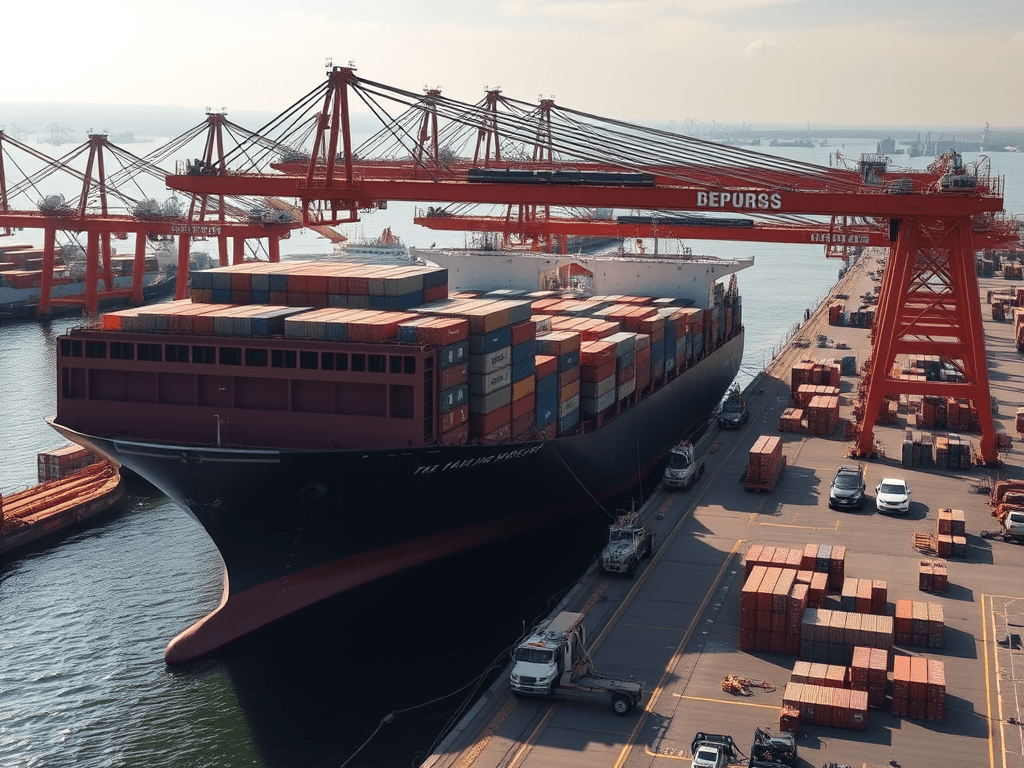
Vizhinjam International Seaport, located in Kerala, has emerged as a transformative project in India’s maritime landscape. As the country’s first semi-automated transshipment port, Vizhinjam is not only boosting India’s container handling capacity but also significantly reducing dependency on foreign ports for transshipment.
Key Data on Vizhinjam International Seaport
| Parameter | Details |
|---|---|
| Port Type | India’s first semi-automated transshipment port |
| Revenue in First 8 Months | ₹450 crore |
| Vessels Docked (to date) | 448 ships |
| Containers Handled | 9.77 lakh |
| Annual Container Movement in India | 2 – 2.5 crore containers |
| Foreign Transshipment Dependence | 25% (approx.) |
| Annual Loss to India (foreign ports) | USD 220 million |
| Current Handling Capacity | 1.5 million containers annually |
| Projected Capacity (by 2028) | 30+ lakh containers annually |
| Berth Expansion | From 800 meters → 2 km (to handle 4 large mother vessels simultaneously) |
| Future Equipment Upgrade | 60 yard cranes & 20 ship-to-shore cranes |
| Connectivity Expansion | Enhanced road & rail links planned |
| Kerala Govt. Revenue Share (from 2034) | 1% annually, increasing 1% each year until 40% (projected ₹25,000 crore) |
| GST Collected (so far) | ₹75 crore |
Strategic Importance
- First-of-its-kind Infrastructure
Vizhinjam’s semi-automated facilities provide operational efficiency and faster turnaround times, aligning India with global standards in transshipment handling. - Reducing Foreign Dependency
Currently, India routes 25% of its containerized cargo via foreign ports like Colombo, Singapore, and Dubai. Vizhinjam reduces this reliance, potentially saving USD 220 million annually. - Capacity for Future Growth
With a current capacity of 1.5 million containers per year, the port is projected to handle over 3 million TEUs (30 lakh containers) by 2028 after expansion. - Boost to Kerala’s Economy
- ₹75 crore already earned in GST revenue.
- Long-term revenue sharing ensures Kerala will benefit progressively, with an estimated ₹25,000 crore over 40 years.
- Infrastructure Expansion
The planned extension of the berth and addition of advanced cranes will allow the port to dock and service the world’s largest mother vessels, making it a global shipping hub.
Conclusion
Vizhinjam International Seaport represents a paradigm shift in India’s maritime capabilities. By cutting down on foreign dependency, scaling up container handling, and ensuring long-term revenue for Kerala, the port is poised to become a key driver of India’s trade competitiveness. With its strategic location on international shipping lanes and its ambitious expansion plans, Vizhinjam is well-positioned to emerge as one of the leading transshipment hubs in Asia by the end of this decade.


 Glottis Limited
Leave a comment