
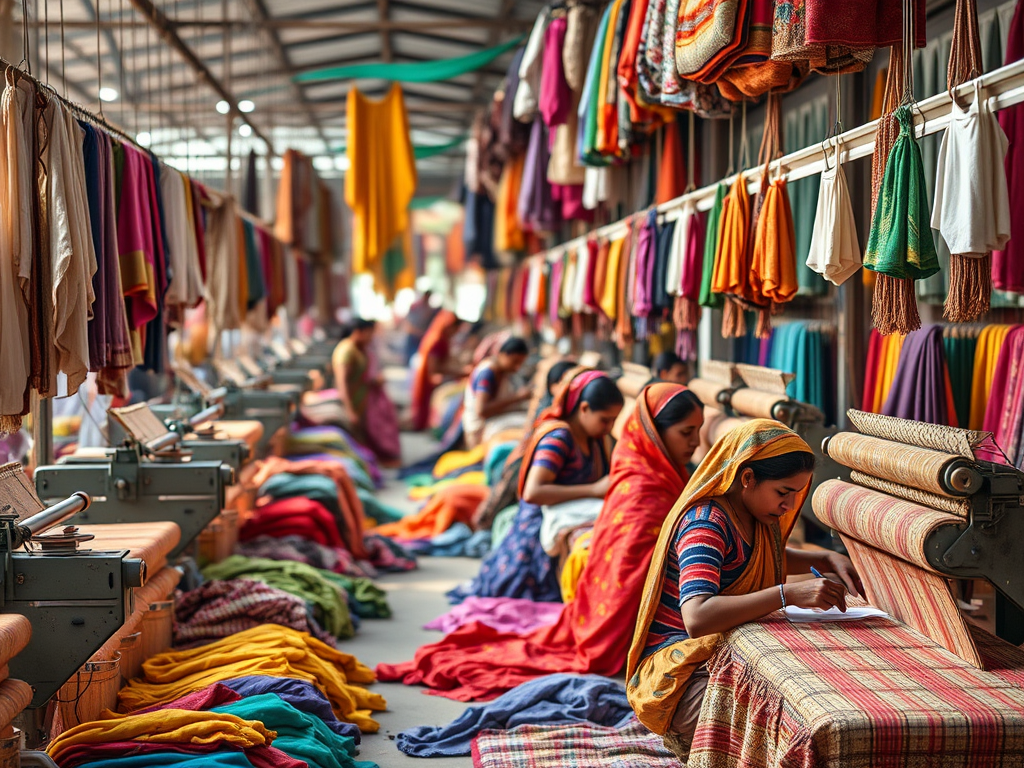
India’s textile and apparel sector, a cornerstone of its export economy, is grappling with new challenges following the U.S. imposition of a 50% tariff on Indian textile shipments. The move has sent ripples across key production hubs like Tiruppur, Noida, and Ludhiana, threatening the competitiveness of Indian exporters in one of their largest markets.
Tariff Shock and Industry Response
The new tariff has hit India’s sixth-largest global textile and apparel export industry, valued at $34.4 billion in FY24, with nearly half of these shipments headed to the U.S. and EU. Exporters are reporting order slowdowns and increased pressure from buyers to share costs, straining margins—particularly for small and medium-sized enterprises (SMEs).
Yet, some businesses remain cautiously optimistic. Vasant Marimuthu, CEO of Teestra Lifestyle, continues to ship samples to the U.S., stating that his customers are willing to absorb part of the additional cost to keep supply chains intact.
Government and Legal Dimensions
Commerce Minister Piyush Goyal has affirmed that India will not bow to U.S. pressure, and instead will look to diversify exports into alternative markets. Meanwhile, a U.S. federal appeals court ruling questioning the legality of tariffs imposed under emergency powers has raised hopes that the 50% tariff may face challenges in the future.
Industry Challenges
The tariff comes at a time when exporters are already navigating rising input costs and weak global demand. SMEs, which form the backbone of the industry, are particularly vulnerable, with many struggling to maintain profitability. Calls for a U.S.-India free trade agreement (FTA) have resurfaced, highlighting the political dynamics behind the trade dispute.
India’s Global Role in Textiles
Despite these challenges, India remains a major player in the global textile and apparel industry. With an annual production capacity of 22,000 million garments and a workforce employing millions across its value chain, the sector is integral to India’s manufacturing and export ecosystem.
Key Data Snapshot
| Aspect | Details |
|---|---|
| Tariff Impact | 50% tariff imposed by the U.S. on Indian textile exports |
| Key Regions Affected | Tiruppur, Noida, Ludhiana |
| Global Ranking | India is the 6th largest textile and apparel exporter |
| Export Value (FY24) | $34.4 billion |
| Major Markets | Nearly half of exports go to the U.S. and EU |
| Annual Production | 22,000 million pieces of garments |
| Employment | Millions across the textile value chain |
| Business Response | Some firms (e.g., Teestra Lifestyle) continue exports, with buyers absorbing costs |
| Government Stance | India will not yield to U.S. pressure; seeks alternative markets |
| Legal Context | U.S. appeals court ruled many emergency-based tariffs unlawful |
| Industry Challenges | Reduced orders, higher costs, SME strain |
| Political Dynamics | Renewed calls for a U.S.-India Free Trade Agreement (FTA) |
Conclusion
India’s textile and apparel exports are at a crossroads. While the 50% U.S. tariff poses immediate hurdles, the sector’s resilience, scale, and global significance suggest it can weather the storm—provided businesses diversify markets and policymakers secure fairer trade terms. The outcome will not only shape India’s textile future but also influence broader U.S.-India trade relations in the years to come.


 Glottis Limited
Leave a comment