
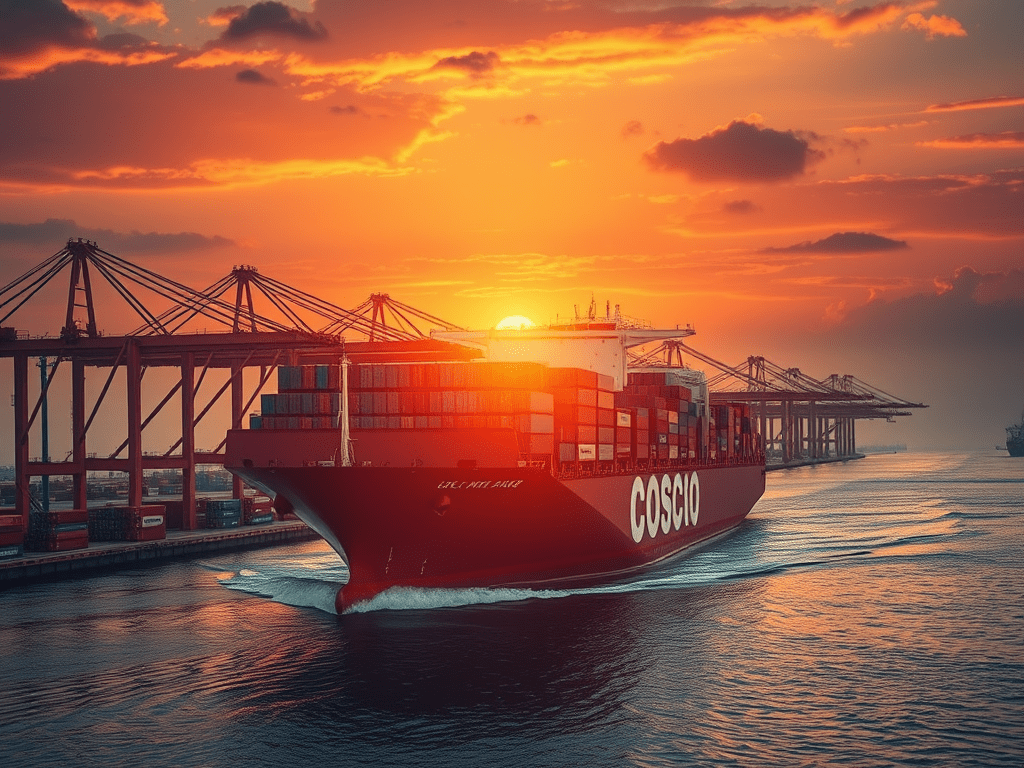
The U.S. government’s upcoming port fees targeting Chinese-linked tonnage are set to significantly disrupt global shipping dynamics, with COSCO and its subsidiary OOCL expected to bear the brunt of the financial impact. The fees, set to begin on October 14, 2025, aim to impose additional costs on carriers utilizing Chinese-built vessels calling at U.S. ports.
Key Financial Impact
| Company | Estimated Fee (2026) | % of Projected Revenue | Notes |
|---|---|---|---|
| COSCO | $1.5 billion | 5.3% | Largest Chinese carrier, directly impacted. |
| OOCL | $654 million | 7.1% | COSCO subsidiary, higher revenue hit in proportion. |
| Combined | $2.1+ billion | — | Reflects the scale of U.S. fee targeting. |
The fee structure is modeled at $600 per FEU (forty-foot equivalent unit) on a 10,000 TEU vessel, a substantial charge when compared with prevailing shipping rates.
Strategic and Operational Adjustments
Both COSCO and OOCL are exploring strategies to reduce the burden of these fees:
- Ocean Alliance Collaboration: Potential reliance on partners CMA CGM and Evergreen to deploy more non-Chinese-built vessels.
- Alternative Routes: Cargo may be rerouted via Mexico, Canada, or Caribbean hubs to bypass U.S. port fees.
- Fleet Realignments: Retention of older, non-Chinese-built ships to avoid penalties, potentially tightening global shipping capacity.
Wider Industry Implications
While COSCO and OOCL are the primary targets, ripple effects are expected across the shipping industry:
| Affected Companies | Details |
|---|---|
| CMA CGM | Ocean Alliance partner; may need to adjust fleet usage to avoid fees. |
| Evergreen | Alliance partner; potential rerouting or vessel deployment changes. |
| Yang Ming | Taiwanese carrier; indirect impact through alliance networks. |
| Hapag-Lloyd | Could feel repercussions from shifting trade flows and tightened capacity. |
| MSC (Mediterranean Shipping Company) | Indirect exposure due to global realignments in tonnage deployment. |
Market Dynamics and Analyst Commentary
- Operational Adjustments: Carriers are expected to explore non-Chinese vessel deployment and diversified routes.
- Strategic Partnerships: Increased cooperation between carriers to mitigate fee exposure.
- Capacity & Rates: Retaining older vessels may tighten global supply, potentially pushing freight rates upward.
Analysts at HSBC emphasize the severe financial hit to state-backed Chinese carriers, while OOCL itself has acknowledged the “likely painful consequences.”
Conclusion
The U.S. port fees represent a significant regulatory shift with direct implications for COSCO and OOCL, but the ripple effects will likely extend across global shipping alliances and carriers. As the October 2025 implementation date approaches, the industry is bracing for capacity reshuffles, higher costs, and evolving trade routes.




 Glottis Limited
Leave a comment