
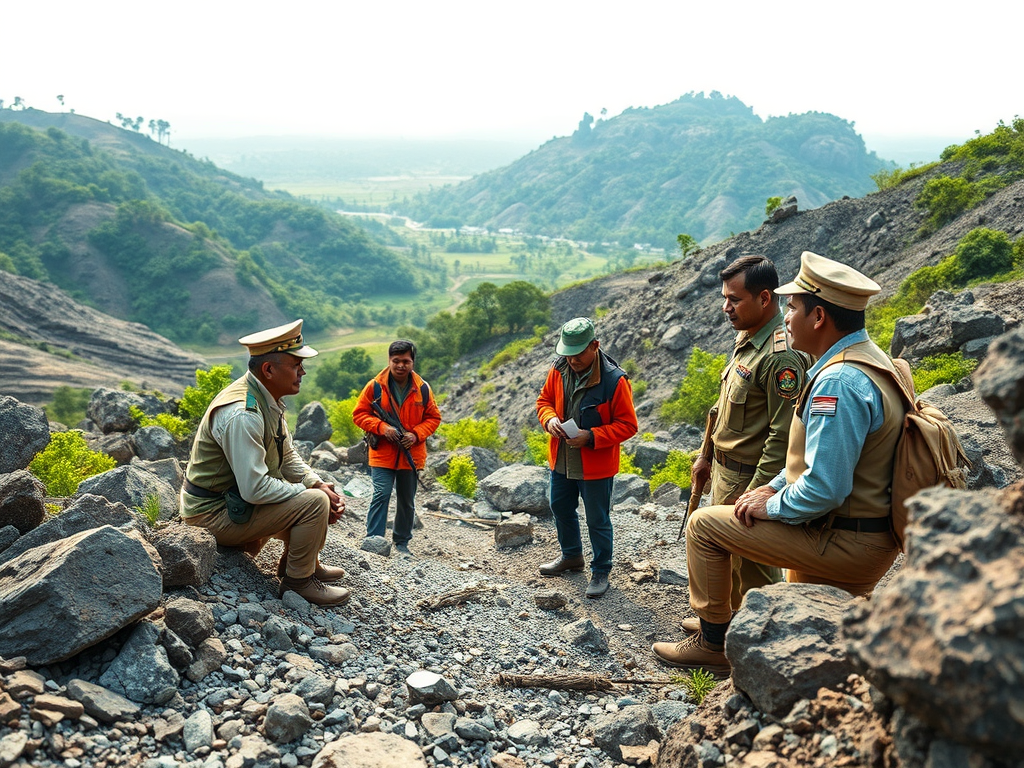
India has intensified efforts to secure critical rare-earth minerals by engaging with Myanmar’s Kachin Independence Army (KIA), a rebel group controlling mineral-rich regions. This move is seen as part of New Delhi’s broader strategy to reduce dependence on China, which dominates global rare-earth processing and recently tightened export restrictions.
Collaboration with KIA
The Indian Ministry of Mines is spearheading discussions with both state-owned firms like IREL and private firms such as Midwest Advanced Materials to procure rare-earth mineral samples from KIA-controlled mines. Initial efforts focus on obtaining samples for laboratory testing in India, specifically targeting heavy rare earths such as dysprosium and terbium, which are crucial for magnets used in electric vehicles, wind turbines, and advanced electronics.
Strategic Drivers
China’s restrictions on rare-earth exports have accelerated India’s urgency to diversify sources. Myanmar’s Kachin state, long a supplier of rare earths to China, has emerged as a key potential alternative. However, logistical hurdles — including transporting bulk minerals from remote and conflict-affected areas — pose challenges to establishing a stable supply route.
India’s long-term vision goes beyond raw material sourcing. The government is seeking to build domestic processing capacity to achieve high-purity rare earths independently, a crucial step to reduce vulnerability to Chinese processing dominance.
Historical and Geopolitical Context
The KIA, established in 1961, has fought for greater autonomy for the Kachin ethnic community and has played a significant role in Myanmar’s complex political landscape, particularly after the 2021 military coup. Its control over rare-earth mines adds a geopolitical layer, as these resources are vital to global supply chains.
Previously, the KIA’s rare earths were largely exported to China, setting the stage for India-China competition over access to these strategic minerals.
India’s Key Strategies for Securing Rare Earths
- Collaboration with KIA: Direct engagement to source minerals from KIA-controlled mines.
- Public-Private Partnerships: Involvement of both state and private firms in collection and transportation.
- Sample Testing: Verification of mineral content in Indian laboratories.
- Long-Term Supply Agreements: Building stable supply chains despite logistical constraints.
- Domestic Processing Facilities: Reducing reliance on Chinese technology.
- Exploration Visits: On-ground evaluation of resource potential in Kachin.
- Geopolitical Maneuvering: Counterbalancing China’s export restrictions.
Key Data from India’s Rare-Earth Initiative
| Aspect | Details |
|---|---|
| Partners in Myanmar | Kachin Independence Army (KIA) |
| Indian Stakeholders | State-owned IREL, private Midwest Advanced Materials |
| Target Minerals | Heavy rare earths (dysprosium, terbium) |
| End Use | Magnets for EVs, wind turbines, advanced electronics |
| Testing | Mineral samples to be analyzed in Indian labs |
| Logistical Challenge | Transporting minerals from remote Kachin state to India |
| Long-Term Plan | Establish stable supply routes and processing capacity in India |
| Geopolitical Driver | Response to China’s rare-earth export restrictions |
| Historical Context | KIA formed in 1961; major player post-2021 coup; previously supplied China |
| Strategic Goal | Diversify supply, reduce Chinese dependence, strengthen resource security |
Conclusion
India’s engagement with Myanmar’s KIA underscores its determination to secure rare-earth minerals critical for its clean energy and high-tech ambitions. While challenges such as logistics, processing technology, and geopolitical sensitivities remain, the initiative highlights India’s shift toward a proactive resource security strategy in an era of strategic competition with China.



 Glottis Limited
Leave a comment