
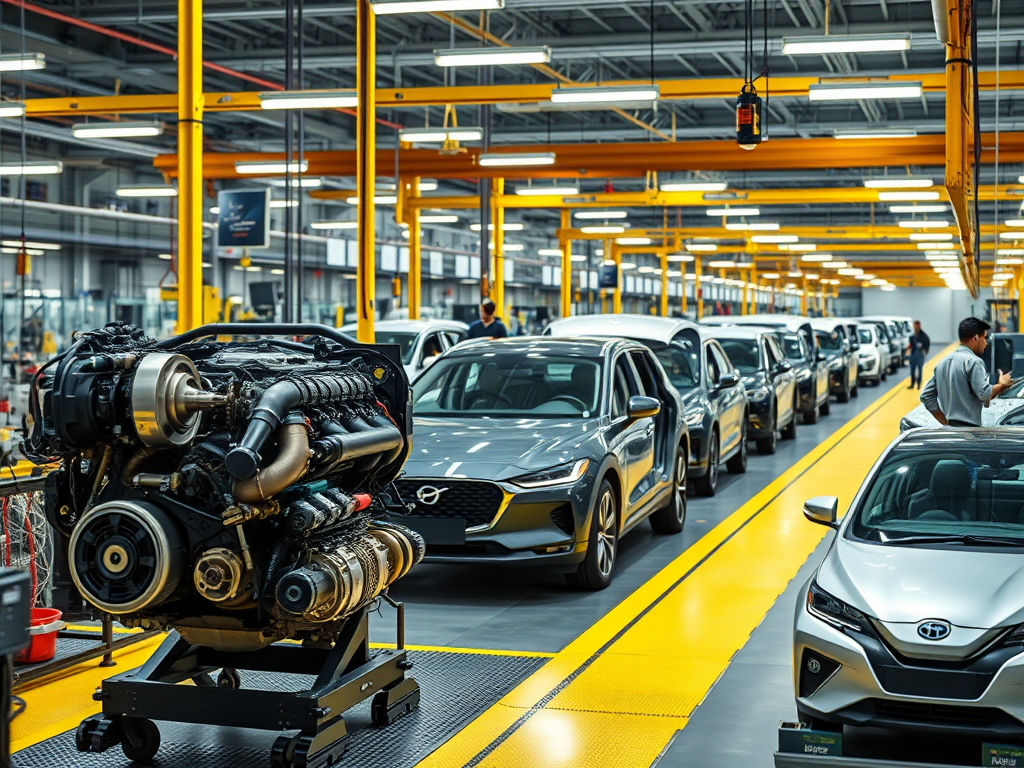
The Indian auto component industry is on the cusp of a major transformation. According to a McKinsey & Company report, the sector is set to triple in size, reaching $200 billion by 2030, positioning India as a critical hub in the global automotive supply chain. With rising domestic demand, rapid adoption of electric vehicles (EVs), and a growing export footprint, India’s component makers are poised for global leadership.
Market Growth and Sales Outlook
India’s domestic auto component sales are expected to grow 7–8% annually until FY30, driven by rising vehicle ownership, higher component intensity per vehicle, and increasing adoption of advanced technologies.
Key Growth Projections for India’s Auto Component Industry
| Indicator | Projection / Trend | Driver |
|---|---|---|
| Market Size | $200 billion by 2030 (3x growth) | Demand, exports, EV adoption |
| Annual Sales Growth | 7–8% until FY30 | Rising vehicle demand, higher parts usage |
| Export Potential | $70–100 billion by FY30 | ICE + EV component demand |
| ICE Component Opportunity | $20–30 billion by FY30 | Sustained ICE demand in emerging markets |
| EV Sales Growth | 35% CAGR domestically | Rapid EV adoption, policy push |
| Global Hub Potential | India seen as a future leader | Supply chain diversification |
Export Potential: ICE and EV Opportunities
Exports are projected to reach $70–100 billion by FY30, with opportunities split between traditional internal combustion engine (ICE) components ($20–30 billion) and the fast-growing EV segment.
India’s domestic EV market is expanding at an impressive 35% CAGR, with two-wheelers and SUVs leading the transition. Suzuki’s decision to select India as the global hub for its first electric SUV, the e-Vitara, underscores global confidence in India’s capabilities.
Supply Chain Diversification and Industry Resilience
The pandemic and geopolitical shifts have accelerated supply chain diversification, with automakers seeking low-risk production bases. India’s suppliers are expanding capacity, while global OEMs diversify sourcing away from China. This positions India as a reliable and resilient manufacturing hub, similar to global leaders like the U.S., Europe, and Japan.
Domestic Market Momentum
- Two-wheeler market: Back to pre-pandemic levels, led by EV scooters.
- Four-wheeler momentum: Global OEMs like Suzuki investing heavily in India for EV production.
- Leadership sentiment: Indian business leaders believe the country can lead, not just participate, in the global auto supply chain.
India vs. Global Auto Component Industry Trends
| Aspect | India | Global |
|---|---|---|
| Market Size & Growth | Projected to triple to $200B by 2030 | Steady growth, EVs driving expansion |
| Annual Sales Growth | 7–8% until FY30 | Varies by region; EV strong, ICE under pressure |
| Export Potential | $70–100B by FY30 (ICE + EV) | Supply chains shifting, EV exports gaining |
| Technology Adoption | Rapid, esp. in EV & digital components | Heavy global investment in EV + automation |
| Supply Chain Diversification | Driven by pandemic & geopolitics | Global trend, esp. away from China |
| EV Growth | Domestic EV sales CAGR of 35% | Exponential global growth in EVs |
| Industry Resilience | Positioning as global hub | Global focus on resilient, flexible supply chains |
| Domestic Market | Two-wheeler recovery, EV-led | Recovery varies by region and vehicle type |
Conclusion
The McKinsey report highlights a once-in-a-generation opportunity for India’s auto component industry. With $200 billion market potential, rising exports ($70–100 billion), and domestic EV adoption at 35% CAGR, India is aligning with global automotive shifts while carving its own leadership path. Supported by supply chain diversification and robust domestic momentum, the industry is not just preparing to grow—it is preparing to lead.




 Glottis Limited
Leave a comment