

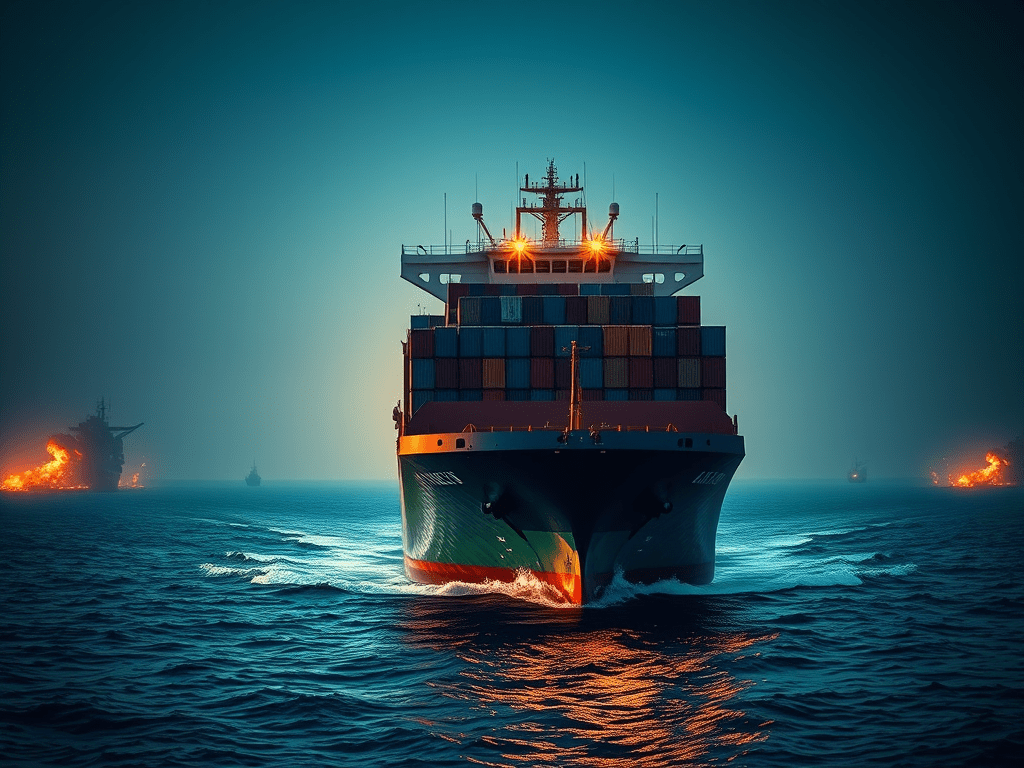
In a landmark development for India’s maritime sector, CMA CGM, one of the world’s leading container shipping companies, has placed an order worth $300 million with Cochin Shipyard Limited (CSL) for the construction of six LNG-powered container ships. This move signals a major leap forward for India’s ambitions in global shipbuilding and green maritime technology.
1. Order Overview
The agreement, formalized through a Letter of Intent (LoI), involves six container ships, each with a capacity of 1,700 TEUs (Twenty-Foot Equivalent Units). This order marks CMA CGM’s first-ever shipbuilding collaboration in India, underscoring the growing confidence in Indian shipyards to deliver complex, energy-efficient vessels that meet international standards.
2. Green Shipping and LNG Power
Each vessel will be powered by Liquefied Natural Gas (LNG), aligning with CMA CGM’s long-term decarbonization strategy and the global shipping industry’s shift toward cleaner fuels. The adoption of LNG propulsion reflects a significant step in meeting the International Maritime Organization’s (IMO) emission targets.
3. Boost for Indian Shipbuilding
This is the first container ship order by a global mainline operator in India, marking a pivotal milestone for the nation’s shipbuilding roadmap. The move supports India’s vision to be among the top 10 shipbuilding nations by 2030 and within the top 5 by 2047, coinciding with its 100th year of independence.
4. Cochin Shipyard’s Proven Capability
Cochin Shipyard has a robust track record of delivering technologically advanced vessels. It has successfully built:
- India’s first indigenously made aircraft carrier (INS Vikrant),
- The nation’s largest dredger, and
- A range of naval and commercial ships,
demonstrating its ability to meet global shipbuilding standards.
5. Policy Support and Financial Incentives
This landmark order has been facilitated by the Government of India’s Shipbuilding Financial Assistance Policy 2.0, which offers incentives to promote construction of advanced, environmentally sustainable ships in India. Such policies aim to position India as a competitive shipbuilding hub capable of attracting large-scale international orders.
6. Industry and Economic Impact
The CMA CGM order is expected to:
- Strengthen India’s integration into the global shipbuilding supply chain.
- Encourage foreign direct investment and technology partnerships.
- Create job opportunities and support the development of local suppliers for maritime components and services.
Moreover, large-scale orders enable economies of scale, improving India’s bargaining position with suppliers and boosting cost efficiencies.
7. Partnerships and Global Credibility
CMA CGM’s partnership with Cochin Shipyard enhances India’s credibility as a trusted global shipbuilding partner. The collaboration is expected to pave the way for future projects with major international players like Maersk, MSC, and Hapag-Lloyd, reinforcing India’s maritime reputation on the world stage.
8. Geopolitical and Strategic Context
India’s neutral geopolitical position has become a key factor in attracting international investments, particularly amid global trade realignments. CMA CGM’s decision reflects strategic diversification—shifting some shipbuilding operations to stable, cost-effective locations outside East Asia.
Summary Table of Key Data
| Key Aspect | Details |
|---|---|
| Order Value | USD 300 million |
| Number of Vessels | 6 container ships |
| Capacity per Ship | 1,700 TEUs |
| Fuel Type | Liquefied Natural Gas (LNG) |
| Shipbuilder | Cochin Shipyard Limited (CSL), India |
| Significance | First container ship order by a global mainline operator in India |
| Policy Support | Backed by Shipbuilding Financial Assistance Policy 2.0 |
| Strategic Objective | Help India reach Top 10 shipbuilding rank by 2030 and Top 5 by 2047 |
| Expected Benefits | Strengthened supply chain, job creation, technology transfer, FDI growth |
| Economic Impact | Enhances India’s competitiveness and maritime ecosystem development |
| Geopolitical Influence | India’s neutral stance attracts global collaboration |
9. CMA CGM’s Global Competitive Landscape
CMA CGM operates in one of the most competitive sectors of global trade. Its major rivals include:
| Company | Headquarters | Key Strengths |
|---|---|---|
| Maersk Line | Denmark | World’s largest carrier; digital and logistics integration |
| MSC (Mediterranean Shipping Co.) | Switzerland | Extensive global fleet and network coverage |
| Hapag-Lloyd | Germany | Strong transatlantic and intra-Europe presence |
| COSCO Shipping Lines | China | State-backed; major player in Asia-Europe routes |
| ONE (Ocean Network Express) | Japan | Merger of NYK, MOL & K Line; efficiency-driven fleet |
| Evergreen Marine Corp. | Taiwan | Large modern fleet; sustainability-focused |
| Yang Ming Marine Transport | Taiwan | Expanding global services |
| Hyundai Merchant Marine (HMM) | South Korea | Rapidly growing fleet; focus on Asia-Europe trades |
| ZIM Integrated Shipping | Israel | Agile operator; technology-driven logistics solutions |
| Pacific International Lines (PIL) | Singapore | Strong regional connectivity in Asia and Africa |
Conclusion
The CMA CGM–Cochin Shipyard collaboration is more than a commercial deal—it’s a strategic shift for India’s maritime future. The order reinforces confidence in India’s technical shipbuilding capabilities, promotes green shipping innovation, and strengthens the country’s presence in global maritime trade.
As more international players evaluate India as a potential shipbuilding hub, this partnership may serve as the catalyst that propels India into the global top tier of shipbuilding nations.



 Glottis Limited
Leave a comment