

How the new trade corridor is expected to reshape freight flows, sourcing strategies, and logistics operations.
Global Trade Is Entering a New Phase
Trade agreements are more than policy announcements—they are catalysts for supply chain transformation. While tariff reductions often dominate the headlines, the real impact is felt across freight networks, sourcing strategies, manufacturing investments, and logistics operations.
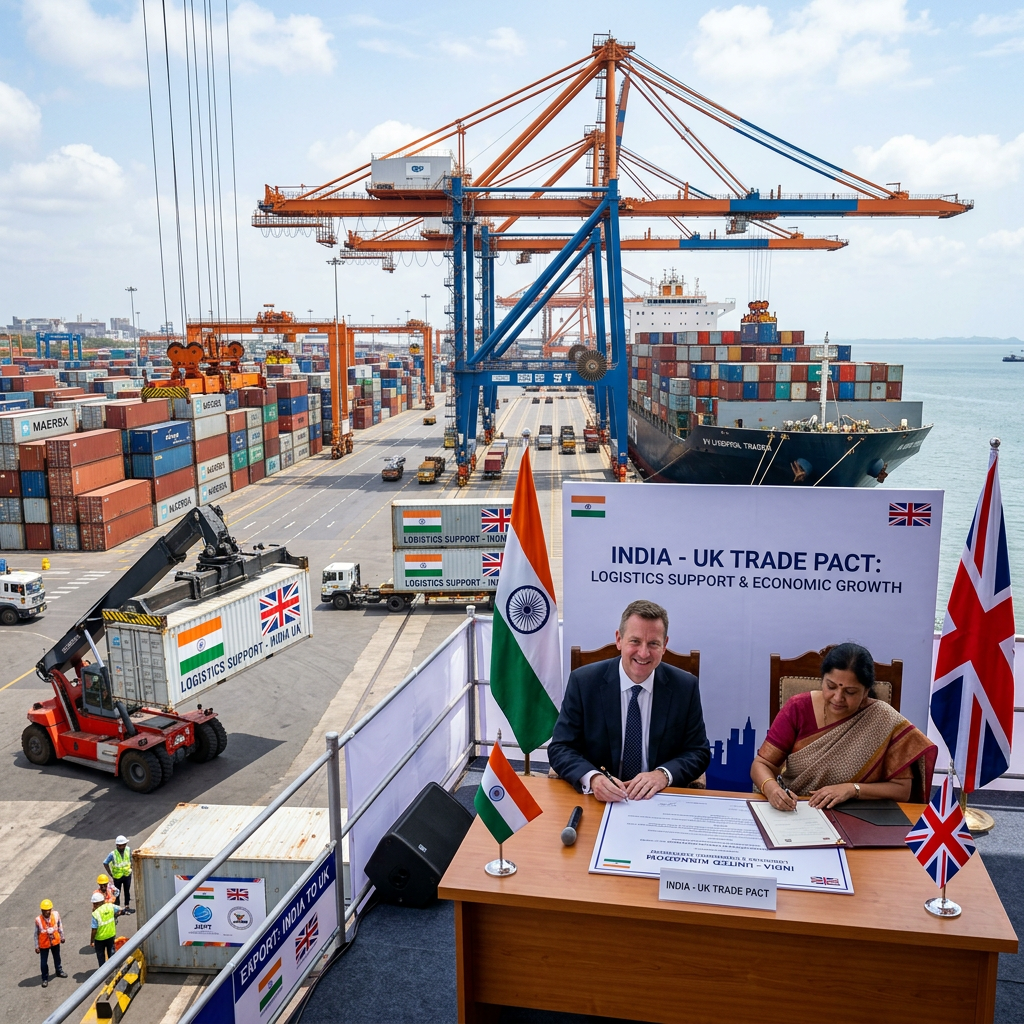
The implementation of the India–UK Comprehensive Economic and Trade Agreement (CETA) marks one of the most significant milestones in India’s international trade strategy. By reducing trade barriers and improving market access, the agreement is expected to strengthen bilateral trade, improve export competitiveness, and accelerate cargo movement between two of the world’s largest economies.
For logistics leaders, the opportunity extends beyond increased trade volumes. It represents a chance to redesign supply chains for greater agility, efficiency, and long-term growth.
Beyond Tariffs: Why This Agreement Matters
Free Trade Agreements reshape how businesses buy, manufacture, store, and distribute goods. Reduced tariffs lower the cost of doing business, but they also encourage companies to expand into new markets, diversify sourcing, and invest in more resilient supply chains.
The India–UK agreement is expected to create momentum across several strategic industries, including engineering, automotive, pharmaceuticals, textiles, chemicals, food processing, and consumer manufacturing.
With 99% of Indian exports by value expected to benefit from preferential access to the UK market, Indian manufacturers gain a stronger competitive position while UK businesses gain improved access to one of the world’s fastest-growing economies.
For logistics providers, these developments typically translate into increased cargo volumes, more diversified freight requirements, and greater demand for integrated logistics solutions.
The Supply Chain Impact
As trade expands, logistics networks must evolve alongside it. Businesses looking to capitalize on the agreement should prepare for changes across three critical areas.
Freight Capacity & Network Optimization
Growing bilateral trade is expected to increase demand for both containerized ocean freight and time-sensitive air cargo.
Rather than reacting to higher shipment volumes, businesses should proactively evaluate carrier partnerships, transportation routes, and multimodal strategies that improve flexibility while maintaining cost efficiency.
Supply chain resilience will increasingly depend on network optimization rather than simply securing freight capacity.
Customs & Trade Compliance
Reduced tariffs do not eliminate complexity—they increase the importance of compliance.
To fully benefit from preferential trade provisions, businesses must ensure accurate product classification, origin documentation, and customs processes. Even minor documentation errors can delay shipments or prevent companies from claiming tariff benefits.
Organizations with strong customs governance will be better positioned to move goods efficiently while minimizing operational risk.
Visibility & Integrated Logistics
As cargo volumes grow, operational visibility becomes a strategic advantage.
Real-time shipment tracking, predictive ETAs, transportation management systems, and digital documentation are no longer optional capabilities—they are becoming standard expectations across global supply chains.
Similarly, warehousing is evolving beyond storage. Distribution centers increasingly serve as strategic hubs for inventory optimization, export consolidation, cross-docking, and regional fulfillment, enabling businesses to respond faster to market demand.
A New Opportunity for Indian Exporters
The agreement positions Indian exporters to strengthen their presence in one of the world’s most established consumer markets.
Industries expected to benefit include:
- Engineering & Industrial Products
- Automotive Components
- Pharmaceuticals & Healthcare
- Textiles & Apparel
- Chemicals
- Food Processing
- Marine Products
- Electrical Equipment
As export volumes increase, businesses will require logistics partners capable of managing freight forwarding, customs clearance, warehousing, and multimodal transportation with greater efficiency and visibility.
Success will depend not only on accessing new markets but also on building supply chains that can scale sustainably.
From Logistics Providers to Strategic Partners
The role of logistics is changing.
Today’s businesses are no longer selecting logistics providers solely on freight rates or transit times. They are looking for partners that can improve operational resilience, optimize transportation networks, reduce supply chain risk, and support long-term business growth.
This shift places greater emphasis on integrated logistics capabilities, including:
- Global Freight Forwarding
- Ocean & Air Freight
- Customs Advisory
- Warehousing & Distribution
- Multimodal Transportation
- Project Logistics
- End-to-End Supply Chain Visibility
As international trade becomes more dynamic, logistics providers play an increasingly strategic role in enabling business continuity and competitive advantage.
Preparing for the Next Phase of Growth
The India–UK CETA creates significant opportunities, but capturing those opportunities requires preparation.
Businesses should begin evaluating whether their current supply chains are equipped to support increased international trade.
Key priorities include:
- Strengthening customs and trade compliance processes
- Optimizing freight networks and transportation routes
- Improving inventory positioning and warehouse strategy
- Investing in digital visibility across the supply chain
- Building partnerships with integrated logistics providers capable of supporting long-term expansion
Organizations that prepare proactively will be better positioned to respond to market demand while maintaining operational efficiency.
The Glottis Perspective
At Glottis Limited, we see trade agreements not simply as economic milestones, but as catalysts for smarter supply chain strategies.
As businesses expand into new international markets, success depends on more than moving cargo—it requires visibility, operational excellence, regulatory expertise, and integrated logistics execution.
Through our capabilities in global freight forwarding, ocean and air freight, customs clearance, warehousing, project logistics, and end-to-end supply chain solutions, we help businesses navigate evolving trade environments with confidence and agility.
Looking Ahead
The India–UK Comprehensive Economic and Trade Agreement represents more than improved market access—it signals the beginning of a stronger trade corridor that will influence freight flows, sourcing strategies, and logistics investments for years to come.
For supply chain leaders, the opportunity lies not only in lower tariffs but in building agile, resilient, and technology-enabled logistics networks that can support sustained international growth.
As global trade continues to evolve, organizations that combine strategic planning with integrated logistics execution will be best positioned to unlock the full potential of this new partnership.




Leave a Reply