
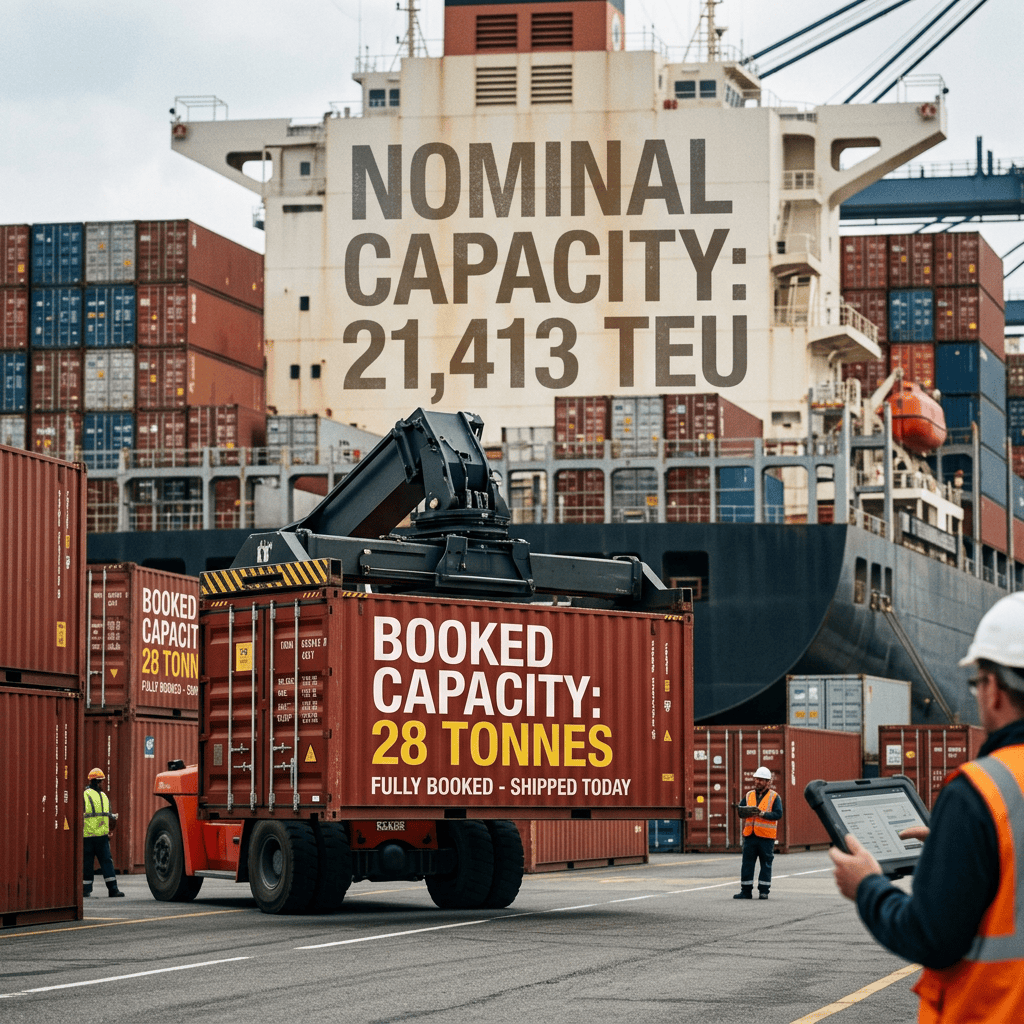
USD 4,500+ per 40HQ. Space being committed weeks in advance.
For shippers moving cargo from China to India, the headline today is freight rates.
But the bigger story is reliable, bookable capacity. 🚢
Earlier this summer, carriers added capacity on the China–India trade. Yet the market is now experiencing:
- 💰 Rising freight rates
- 🎟️ Space tightening well ahead of sailing
- 🔄 Increasing rollovers and schedule changes
- ⚠️ Port omissions reducing effective capacity
- 🚢 Congestion at key China ports disrupting vessel rotations
The important distinction: Capacity is not just capacity.
There are three different types of capacity in today’s market:
📊 Nominal Capacity
What the published schedule says is available.
⚙️ Effective Capacity
What actually operates as planned.
🎟️ Bookable Capacity
What a shipper can actually secure when the booking is made.
And the gap between these three is becoming increasingly important.
A 6,000-TEU vessel waiting outside a congested port technically represents capacity.
For the shipper waiting for a slot?
It’s a beautiful ship—but a useless slot. 😅
📅 The Calendar Is Adding More Pressure
The coming months could make the situation even tighter.
🇨🇳 25–27 September: Mid-Autumn Festival
🇨🇳 1–7 October: Golden Week
Ahead of Golden Week, factories accelerate production, exporters pull bookings forward and carriers face increased demand for available slots.
Then comes the Indian festive and year-end cycle:
🇮🇳 Gandhi Jayanti
🏹 Dussehra
🪔 Diwali
🎄 Christmas
📦 Year-end shipments
🗓️ January planning
And finally:
🧧 Chinese New Year – 6 February 2027
For anyone familiar with China sourcing, the impact of CNY begins weeks before the official holiday.
So, Will USD 4,500 Become USD 5,000?
That may happen.
But that’s not the question shippers should be asking.
The more important question is:
How much reliable, bookable capacity will actually be available when everyone needs it?
Once shippers become concerned about losing space, behaviour changes:
Earlier bookings → Fuller vessels → Less available space → More advance bookings → Rate pressure
And suddenly the conversation becomes:
☎️ “Can you secure next week’s vessel?”
🚢 “We can. But the next confirmed space is three weeks away.”
What Should Importers Do?
The strategy is becoming increasingly clear:
🧭 PLAN EARLIER
Don’t wait until the cargo is ready to start looking for space.
🚢 BOOK EARLIER
Secure allocation before the market tightens further.
🔄 BUILD A BACKUP
Have an alternative carrier, sailing or routing ready.
📊 WATCH EFFECTIVE CAPACITY
Don’t look only at published schedules. Monitor actual vessel performance, rollovers, omissions and port congestion.
The Forwarder’s Role Is Changing
This environment creates an important opportunity for freight forwarders.
The value is no longer simply:
“I can give you a freight rate.”
It is:
“I can give you reliable space, the right routing, visibility and a contingency plan when the original plan fails.”
That is a very different value proposition.
China → India is no longer simply a rate problem.
It is increasingly a reliability problem.
Because a freight rate can change overnight.
But a missed sailing can cost days or even weeks.
And between now and Chinese New Year, time could become the most expensive part of the shipment. ⏳
Cargo doesn’t move on nominal capacity.
It moves on the space you can actually book. 📦




Leave a Reply